“You want to feel comfortable without a bra, but are you afraid of the scars?”
This is one of the most honest questions many women ask before considering breast lift surgery. They may feel uncomfortable with sagging, loss of breast shape, downward-facing nipples or the way the breasts sit in clothing. They may want a more lifted, youthful and proportionate breast appearance. But then comes the concern: “What about the scars?”
That concern is completely understandable.
Breast lift surgery, medically known as mastopexy, reshapes the breast by removing excess skin, lifting the breast tissue and repositioning the nipple-areola area when needed. Since skin must be removed and reshaped, incisions are part of the procedure. And where there is an incision, there will be a scar.
The key question is not “Will there be scars?” The honest answer is yes. A better question is: “Where will the scars be placed, how do they usually mature, and how visible are they likely to be over time?”
At Merientis Health in Istanbul, Turkey, breast lift planning should always include a clear conversation about scars. A responsible surgical consultation does not hide this topic. On the contrary, it explains incision options, scar placement, healing stages, underwear coverage, skin quality and realistic expectations before surgery.
Because for many women, the fear of scars is not only about the skin. It is about confidence, femininity, intimacy and whether the result will feel worth it in daily life.
What Is Breast Lift Surgery?
Breast lift surgery is a procedure designed to lift and reshape sagging breasts. It does not primarily aim to make the breasts much larger or significantly smaller. Its main goal is to improve breast position, remove excess loose skin and create a firmer, more elevated breast contour.
Breast sagging can occur for many reasons. Pregnancy, breastfeeding, weight fluctuations, aging, genetics, skin elasticity and gravity can all affect breast shape over time. Some women notice that the upper part of the breast looks empty. Others feel that the nipple sits lower than before or points downward.
A breast lift can help reposition the breast tissue and nipple-areola complex according to the patient’s anatomy. In some cases, it may be combined with breast augmentation or breast reduction, but mastopexy itself is mainly about lifting and reshaping.
However, lifting the breast requires removing excess skin. This means incisions are necessary. The type of incision depends on the degree of sagging, breast volume, skin quality, nipple position and the surgical plan.
Why Do Breast Lift Scars Happen?
Scars happen because the body repairs the skin after an incision. This is a natural part of healing. During breast lift surgery, the surgeon makes planned incisions to remove excess skin and reshape the breast. After the skin is closed, the body begins producing collagen to repair the area.
In the early phase, scars may look red, pink, firm, raised or darker than the surrounding skin. This can worry patients, especially if they expected the scars to be very faint immediately. But early scars are not final scars.
Scar healing is a long process. Over time, scars generally soften, flatten and become lighter. They may become much less noticeable, especially when placed in natural breast borders and areas usually covered by underwear or swimwear. Still, scars do not completely disappear.
This is one of the most important points to understand before surgery: breast lift scars can fade, but they are permanent. The aim is to place them as discreetly as possible and support proper healing, not to pretend they will vanish entirely.
What Is an Inverted-T Breast Lift Scar?
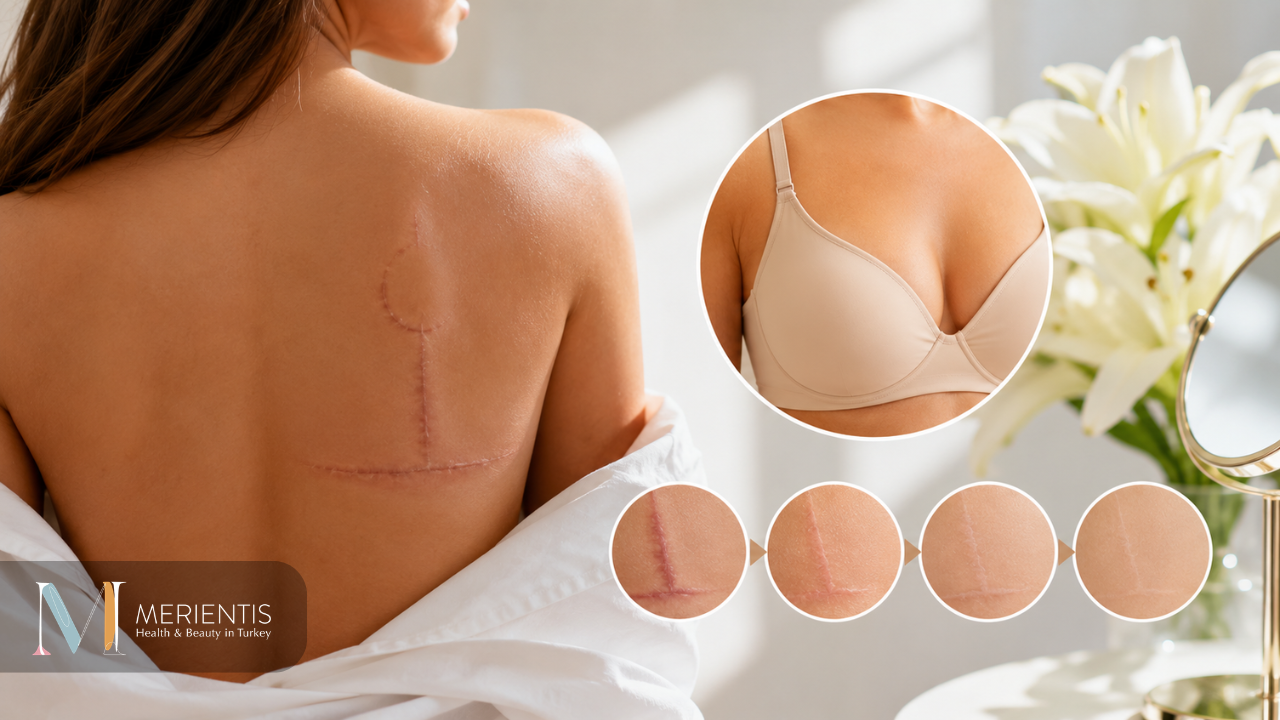
An inverted-T scar, also called an anchor scar, is one of the common incision patterns used in breast lift surgery, especially when there is moderate to significant sagging. It is called “inverted-T” because the final scar pattern resembles an upside-down T shape.
This pattern usually includes three parts:
A circular scar around the areola
A vertical scar from the lower edge of the areola to the breast fold
A horizontal scar along the crease under the breast
The circular scar is placed around the natural border of the areola, where the color transition between areola and breast skin can help make the scar less obvious over time. The vertical scar sits on the lower part of the breast. The horizontal scar lies in the inframammary fold, the natural crease beneath the breast.
Many women are most concerned about the horizontal scar. But in many cases, this part is hidden under the breast fold and covered by bras, underwear and many bikini tops. The vertical scar may be more visible in the early period, but it often softens and fades gradually.
An inverted-T scar is not used to create unnecessary scarring. It is selected when the breast needs a stronger reshaping and more skin removal than a smaller incision pattern can provide.
Why Is the Inverted-T Technique Sometimes Necessary?
Many patients naturally ask, “Can I have a breast lift with fewer scars?” This is a fair question. Some breast lifts can be performed with shorter incision patterns, such as a periareolar or vertical technique. However, not every breast is suitable for limited scars.
When sagging is more advanced, when there is significant excess skin, or when the nipple needs to be lifted more substantially, a smaller incision may not allow enough reshaping. Trying to use a minimal scar technique in a breast that needs more correction may lead to an unsatisfactory shape, poor skin tightening or early recurrence of sagging.
This is where the inverted-T technique can be useful. It gives the surgeon more control over skin removal, breast shaping and nipple positioning. In selected patients, it may help create a more stable and balanced breast contour.
So the decision is not simply “small scar versus big scar.” The real question is: “Which incision pattern can create the most appropriate shape for this breast structure?”
At Merientis Health in Istanbul, Turkey, incision planning should be individualized. The best technique is not the one that sounds easiest; it is the one that matches the patient’s anatomy and goals most responsibly.
Do Breast Lift Scars Fade Over Time?
Yes, breast lift scars generally fade over time, but they do not disappear completely. This distinction matters. A scar that looks pink, red or firm in the first months may become paler, softer and flatter as it matures.
In many patients, scars continue changing for 12 months or longer. Some scars may mature more quickly, while others take more time. Skin type, genetics, incision tension, wound healing, smoking, sun exposure, nutrition and postoperative care can all influence scar appearance.
It is common for scars to look more noticeable before they become better. This can feel frustrating, but it is part of the normal scar maturation process. A patient may look in the mirror a few weeks after surgery and think, “Will these always look like this?” In most cases, the early appearance is not the final appearance.
However, it is also important to be realistic. Some people naturally form darker, thicker or more raised scars. This tendency may be related to skin type, family history or individual healing response. A careful consultation should discuss these possibilities before surgery.
What Do Breast Lift Scars Look Like in the First Weeks?
In the first weeks after surgery, breast lift scars are usually fresh and more visible. The skin may appear pink, red, slightly raised or firm around the incision lines. There may be swelling, bruising, tightness and sensitivity as the breast tissue heals.
This early stage is not the time to judge the final result. The breast shape may also look higher, firmer or more swollen than expected. The body needs time to settle. The scars need time to mature.
Some patients feel emotionally sensitive during this period. They may be happy that the breasts look lifted but worried because the scars look more obvious than imagined. This emotional contrast is very normal.
The best approach is to follow postoperative instructions carefully and avoid comparing your healing process with someone else’s photos. Every body heals differently.
How Do Scars Change Month by Month?
Scar healing is not a straight line. Some weeks look better, some weeks feel slower. But in general, scars pass through several stages.
During the first weeks, the incision lines are still healing. The priority is wound closure, protection and avoiding tension. The scars may look red or pink.
Over the next few months, the scars may become firmer or slightly more noticeable before they begin softening. This is because collagen is actively remodeling under the skin.
Between several months and one year, many scars gradually flatten, lighten and become less visible. In some patients, scar maturation may continue beyond one year.
This is why patience is essential. A breast lift scar at six weeks is not the same as a breast lift scar at six months. A six-month scar is not always the same as a one-year scar.
If you are considering breast lift surgery in Istanbul, Turkey, it is helpful to plan emotionally for this timeline. Scars need time, and judging them too early can create unnecessary anxiety.
Are Breast Lift Scars Hidden Under Underwear?
In many breast lift techniques, incision placement is designed with underwear and swimwear coverage in mind. This is especially true for the horizontal part of the inverted-T scar, which usually lies along the natural fold under the breast.
The scar around the areola is placed at the edge of the areola, where the color difference can help soften its appearance over time. The vertical scar may be more visible when the breast is uncovered, but it is usually positioned on the lower part of the breast.
Most standard bras cover the inframammary fold scar. Many bikini tops and lingerie styles also cover the horizontal component. However, coverage depends on the type of clothing, breast size, scar position and surgical technique.
The goal is not to create invisible scars. The goal is to place scars in areas that are as discreet and manageable as possible while achieving the necessary lift and reshaping.
This is an important conversation to have before surgery. If scar visibility in certain clothing or intimate situations is a major concern, it should be discussed openly with the surgeon.
Can You Walk Around Without a Bra After a Breast Lift?
Many women considering mastopexy dream of feeling more comfortable without a bra. This may mean different things for different people. For one woman, it may mean feeling more confident in a dress. For another, it may mean feeling less dependent on heavy support. For someone else, it may simply mean wanting the breasts to sit higher and feel more proportionate.
A breast lift may improve breast position and shape, but it does not stop natural aging, gravity, weight changes or skin changes. It also does not mean a person should ignore support recommendations during recovery.
In the early postoperative period, wearing a surgical bra or supportive garment may be necessary according to the surgeon’s instructions. The tissues need time to heal and settle. Going without support too early may not be appropriate.
After recovery, whether a person feels comfortable without a bra depends on breast size, skin quality, surgical result, lifestyle and personal preference. A breast lift can support a more elevated shape, but realistic expectations remain important.
Why Scar Placement Matters
Scar placement is one of the most important parts of breast lift planning. A scar cannot be erased, but its position can often be planned strategically. This is why incision design should match the patient’s anatomy.
Around the areola, the scar benefits from the natural color transition. Under the breast, the scar can often be hidden in the fold. The vertical scar is harder to hide completely, but careful closure and time can help it become less noticeable.
The surgeon also considers skin tension. Scars that heal under excessive tension may become wider or thicker. Good surgical planning aims to reduce unnecessary tension where possible.
At Merientis Health in Istanbul, Turkey, breast lift surgery should include a detailed discussion of incision pattern, scar location and expected scar maturation. Patients should know where scars will be, not discover them only after surgery.
What Factors Affect How Scars Heal?
Scar healing is personal. Two patients may have the same incision pattern but heal very differently. This is because scars are influenced by many factors.
Genetics plays a major role. Some people naturally form fine, pale scars, while others are more prone to thick, raised or darker scars. Skin tone may also influence pigmentation changes.
Smoking can negatively affect wound healing. Poor nutrition, uncontrolled medical conditions, infection, excessive tension, sun exposure and not following postoperative instructions can also affect scar quality.
Age, skin elasticity and previous scar history are also relevant. If a person has a history of keloids or hypertrophic scars, this should be discussed before surgery.
A good consultation should not guarantee perfect scars. It should explain what can be controlled, what can be optimized and what depends on the body’s own healing response.
How Can Patients Support Better Scar Healing?
Scar care should always follow the surgeon’s instructions. The right timing matters. Some products or treatments should not be started until the incisions are fully healed.
General principles may include keeping incisions clean and protected, avoiding unnecessary tension, wearing recommended support garments, avoiding smoking and attending follow-up appointments. Sun protection is also important because sun exposure can darken scars and make them more noticeable.
Silicone gels or silicone sheets may be recommended in some cases once the wounds have closed. Scar massage may also be suggested at an appropriate time, depending on the surgeon’s protocol.
However, patients should not start scar creams, tapes, oils, massage or laser treatments on their own. What is helpful for one patient may not be suitable for another, especially in the early healing period.
The most important rule is simple: protect first, treat later, and follow medical guidance.
Do All Breast Lift Techniques Leave the Same Scars?
No. Breast lift scar patterns vary depending on the technique. The most common patterns include periareolar, vertical and inverted-T incisions.
A periareolar lift places the incision around the areola. It may be suitable for selected patients with mild sagging, but it does not provide enough reshaping for every case.
A vertical lift includes a scar around the areola and a vertical line down to the breast fold. It may be used in patients with moderate sagging.
An inverted-T lift includes the areola scar, vertical scar and horizontal scar under the breast. It is often selected when more skin removal and reshaping are needed.
Choosing the smallest possible scar is not always the best choice. If the breast requires more lifting than a limited incision can provide, the result may not be stable or aesthetically satisfying.
The incision should match the problem. This is why individualized planning matters so much.
Are Inverted-T Scars Always Very Noticeable?
Not necessarily. Inverted-T scars may be more extensive than smaller incision patterns, but their visibility changes over time. The horizontal scar is often hidden in the breast fold. The areola scar can blend with the natural color transition. The vertical scar tends to be the most visible at first but may fade with time.
The final visibility depends on healing, skin type, scar care, incision tension and surgical technique. Some patients heal with fine, pale lines. Others may develop more noticeable scars.
It is better to think of inverted-T scars as a trade-off. They allow more reshaping in breasts with greater sagging, but they also create a larger scar pattern. For some patients, the improved breast position and contour may feel worth that trade-off. For others, scar concern may be a major deciding factor.
A patient should not be pressured in either direction. The decision should be made with clear information and realistic expectations.
Can Breast Lift Scars Be Completely Removed Later?
Scars cannot be completely removed. Some treatments may improve the appearance of scars, but no method can return the skin to a completely scar-free state.
If scars become thick, raised, dark or wide, the surgeon may discuss scar management options after proper healing. These may include silicone therapy, massage, steroid injections, laser treatments or scar revision in selected cases.
However, scar treatments should be individualized and timed appropriately. Treating too early or using the wrong method can create problems. Patience is often part of scar management.
The best scar strategy begins before surgery: proper incision planning, careful surgical technique, healthy healing conditions and consistent postoperative care.
What If I Have Darker Skin?
Patients with darker skin tones may be more prone to pigmentation changes or thicker scar responses in some cases. This does not mean breast lift surgery cannot be considered. It means scar expectations and care should be discussed carefully.
Some scars may become darker before they fade. Some may stay more visible for longer. A history of keloid or hypertrophic scarring is especially important to mention during consultation.
Sun protection and proper scar care may be particularly important for pigmentation management. However, scar products should still only be used when the surgeon confirms it is safe to begin.
At Merientis Health in Istanbul, Turkey, scar planning should respect individual skin characteristics. A patient’s skin history is not a small detail; it is part of the surgical planning conversation.
Breast Lift Scars and Intimacy: A Real Concern
It is common for women to worry not only about how scars look in the mirror, but also how they may feel in intimate moments. This concern is deeply personal and should not be dismissed.
A woman may think: “Will I feel self-conscious?” “Will the scars be obvious?” “Will I regret choosing the surgery?” These questions are part of the emotional side of breast lift surgery.
The answer is not the same for everyone. Some patients accept scars easily because they feel happier with the lifted shape. Others need more time to adjust emotionally, especially during the early healing phase when scars are still visible.
This is why informed consent must include emotional expectations too. Surgery changes the body, and the mind sometimes needs time to catch up with that change.
Breast Lift Scars and Clothing Choices
One of the practical advantages of breast lift scar placement is that many incision lines are positioned where bras, underwear and swimwear can cover them. The under-breast scar, in particular, often stays hidden in the natural fold.
Low-cut tops, certain bikini styles or very minimal lingerie may reveal more depending on the scar pattern and breast shape. This is why patients should discuss clothing preferences if they have specific concerns.
Some women are more worried about being seen in a bikini. Others are mainly concerned about private visibility. Others simply want to know whether daily clothing will hide the scars.
These are all valid questions. A surgical consultation should feel like the right place to ask them.
Will the Breast Lift Result Last Forever?
A breast lift can improve breast position and shape, but it cannot stop aging, gravity, pregnancy, weight changes or skin elasticity changes. Over time, the breasts may naturally change again.
Wearing supportive garments when appropriate, maintaining a stable weight and following healthy lifestyle habits may help preserve the result. However, natural changes are part of life.
This also matters for scars. As breasts change over time, scar position and visibility may also be perceived differently. Long-term satisfaction depends on both surgical planning and realistic expectations.
A breast lift should be viewed as a reshaping procedure, not a permanent pause button on the body.
Why Is Breast Lift Surgery Frequently Researched in Istanbul, Turkey?
Istanbul, Turkey is widely researched for plastic surgery by both local and international patients. Breast lift surgery is among the procedures women commonly investigate after pregnancy, breastfeeding, weight loss or age-related breast sagging.
Patients researching breast lift surgery in Istanbul often want clear information about incision types, scar placement, recovery, breast shape, safety, travel planning and follow-up. Scar concerns are usually one of the most important parts of this research.
At Merientis Health in Istanbul, Turkey, breast lift surgery should be discussed through a patient-centered and realistic approach. The goal is not to minimize the importance of scars or overpromise scar disappearance. The goal is to explain what scars are expected, how they may mature and how they are usually positioned.
This kind of transparent communication helps patients make more informed decisions.
What Questions Should You Ask Before a Breast Lift?
Before breast lift surgery, patients should feel comfortable asking detailed questions about scars. These questions are not superficial. They are central to the decision.
Useful questions may include:
Which incision pattern is suitable for my breast structure?
Will I need an inverted-T scar?
Where exactly will the scars be placed?
Will the scars be hidden under underwear?
How long do scars usually take to fade?
What can I do to support scar healing?
Do I have risk factors for thicker or darker scars?
When can I begin scar care?
Can I see examples of scar patterns during consultation?
How will the breast shape change as swelling decreases?
A good consultation should answer these questions clearly. The patient should leave understanding both the expected benefits and the scar trade-off.
How Should Expectations Be Managed?
Expectation management is one of the most important parts of breast lift surgery. A patient may feel excited about a lifted breast shape but afraid of scars. Both feelings can exist at the same time.
The honest expectation is this: breast lift scars are permanent, but they usually become less noticeable over time. They are often placed in areas that can be covered by underwear or swimwear. Their final appearance depends on surgical technique, skin type, healing response and postoperative care.
A patient should not expect scar-free surgery. She also should not assume that all scars remain bright, raised or highly visible forever. The truth is usually somewhere in between: scars exist, but they mature.
The goal is to decide whether the improvement in breast shape, position and comfort is worth the scar pattern for that individual patient.
Conclusion: Breast Lift Scars Fade, But Honest Expectations Matter
Breast lift surgery requires incisions, and incisions leave scars. This is the honest starting point. However, breast lift scars usually change significantly over time. They may soften, flatten and fade as the healing process continues.
Inverted-T scars may sound intimidating at first, but their placement is often planned to remain as discreet as possible. The horizontal scar usually sits in the breast fold and is often hidden by bras, underwear and many swimwear styles. The areola scar may blend with the natural color transition. The vertical scar may be more visible early on but can become less noticeable with time.
At Merientis Health in Istanbul, Turkey, breast lift planning should include open discussion about scar patterns, healing expectations, underwear coverage and long-term changes. A patient should not be promised invisible scars. She should be given realistic, respectful and useful information.
If you want to feel more comfortable with breast position but feel afraid of scars, that fear is valid. The healthiest next step is not to ignore it, but to discuss it clearly during a professional medical consultation.
A breast lift is not about choosing between confidence and scars. It is about understanding the trade-off, knowing what to expect and making a decision that feels right for your body, your lifestyle and your expectations.
Frequently Asked Questions
Do breast lift scars go away completely?
No. Breast lift scars do not disappear completely. They are permanent, but they usually fade, soften and become less noticeable over time.
How long do breast lift scars take to fade?
Scar maturation varies from person to person. Many scars continue changing for 12 months or longer. Some patients may notice improvement earlier, while others need more time.
What is an inverted-T breast lift scar?
An inverted-T scar, also called an anchor scar, includes a scar around the areola, a vertical scar down to the breast fold and a horizontal scar along the crease under the breast.
Are inverted-T scars hidden under underwear?
The horizontal part of the inverted-T scar is usually placed in the natural fold beneath the breast and is often covered by bras, underwear and many swimwear styles. Visibility depends on clothing style, scar position and healing.
Is a breast lift possible without scars?
No surgical breast lift is completely scar-free. Any procedure that removes skin and reshapes the breast requires incisions, and incisions leave scars.
Why would someone need an inverted-T breast lift?
An inverted-T pattern may be needed when there is moderate to significant sagging or excess skin. It allows more reshaping than smaller incision patterns in selected patients.
Can scar creams or silicone sheets help?
Scar care products such as silicone gels or sheets may be recommended after the incisions are fully healed. They should only be used when approved by the surgeon.
What affects breast lift scar healing?
Genetics, skin tone, smoking, sun exposure, wound healing, scar care, incision tension, nutrition and postoperative instructions can all influence scar appearance.
Can darker skin develop more visible scars?
Some patients with darker skin may be more prone to pigmentation changes or thicker scars. A history of keloids or hypertrophic scars should be discussed before surgery.
Why is breast lift surgery researched in Istanbul, Turkey?
Istanbul, Turkey is frequently researched for plastic surgery, including breast lift surgery. Many patients seek clear information about breast reshaping, scar placement, recovery and realistic expectations before deciding on treatment.