“Will removing your cheek fat make your face look hollow in the future?”
This is probably the most important question to ask before considering buccal fat removal. Because cheek slimming surgery, also known as bichectomy or buccal fat pad removal, may sound like a small and simple procedure. But when it comes to the face, even small changes can create long-term effects.
Many people discover buccal fat removal through social media. They see sharper cheekbones, a more sculpted lower face and a slimmer facial contour. The result looks clean, defined and photogenic. Naturally, the idea becomes tempting.
But here is the part that is not always discussed enough: not every round face needs buccal fat removal. Not every full cheek is caused by buccal fat. And not every patient will age well after cheek fat removal.
At Merientis Health in Istanbul, Turkey, buccal fat removal should be approached with careful facial analysis, not trend-based decision-making. The question is not only “Can the cheeks be made slimmer?” The real question is: “Should this face lose volume from this area?”
Because a youthful face naturally has volume. Removing volume from the wrong face, at the wrong age or in the wrong amount may create a tired, hollow or prematurely aged appearance over time.
What Is Buccal Fat Removal?
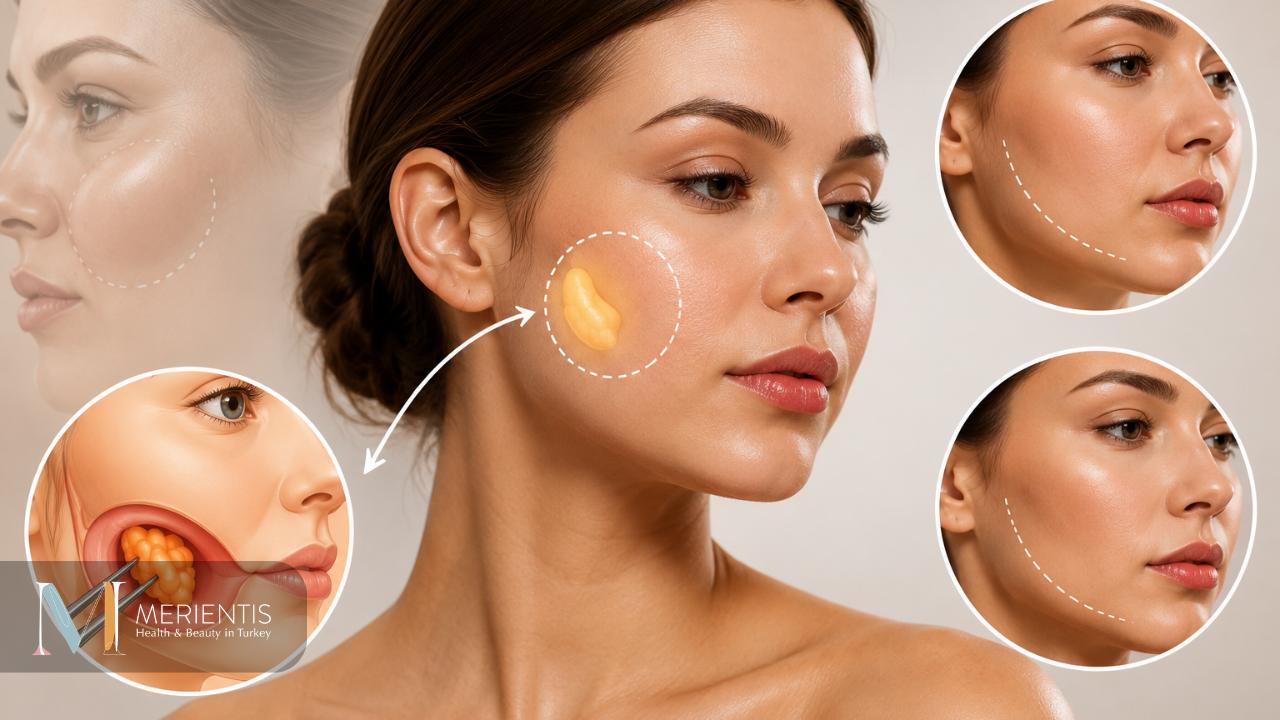
Buccal fat removal is a surgical procedure that reduces the buccal fat pads located in the lower cheek area. These fat pads sit deep within the cheeks and contribute to facial fullness, especially in the mid-to-lower cheek region.
In suitable patients, reducing this fat pad may help create a more defined cheek contour and make the face look less rounded. The incision is usually made inside the mouth, so there is typically no visible external scar on the skin.
However, the absence of an external scar does not mean the procedure is minor or risk-free. The buccal fat pad is located near important facial structures, including facial nerve branches and the parotid duct, which is related to saliva drainage.
This is why buccal fat removal should never be treated as a quick beauty trend. It is a surgical procedure that requires anatomy-based planning, conservative judgement and realistic expectations.
Why Is Patient Selection So Important?
Patient selection is the heart of buccal fat removal. The same procedure that may create a balanced contour in one person may create a hollow or aged look in another. This is because every face has a different fat distribution, bone structure, skin quality and aging pattern.
A naturally full, round face with strong cheekbones may respond differently from a narrow face with limited midface volume. A young patient with thick facial tissue may not age the same way as an older patient who is already losing facial fullness.
The buccal fat pad also plays a role in facial softness. Removing too much or removing it from the wrong person may reduce the natural cushion of the cheek. That may look attractive in a certain lighting or camera angle today, but could become less flattering as facial volume naturally decreases with age.
At Merientis Health in Istanbul, Turkey, the decision should not be based only on whether the patient wants sharper cheekbones. The surgeon should evaluate whether the face can safely and aesthetically tolerate volume reduction in that area.
Who Should Not Have Buccal Fat Removal?
Buccal fat removal may not be suitable for several groups of patients. The most obvious group is people who already have a thin or narrow face. If the cheeks are not truly full, removing buccal fat may create unnecessary hollowness.
It may also be unsuitable for patients with weak cheekbone structure. Buccal fat removal often works best when the cheekbones already have enough projection to support a sculpted look. If the cheekbones are flat or underdeveloped, reducing cheek volume may not create definition; it may simply make the face look tired.
Patients with early facial volume loss should also be cautious. As people age, the face naturally loses fat and soft tissue support. If a person already has under-eye hollowness, midface flattening or visible lower cheek depression, buccal fat removal may make these features more noticeable over time.
It may not be appropriate for patients who are strongly influenced by social media trends, have unrealistic expectations or want a dramatic transformation based on someone else’s face. Facial surgery should be planned for the person’s own anatomy, not for a filter, celebrity photo or temporary beauty trend.
Can Buccal Fat Removal Make the Face Look Hollow Later?
Yes, in some patients, buccal fat removal can contribute to a hollow appearance over time. This does not mean everyone who has the procedure will look hollow. But the risk is real enough to be discussed honestly before surgery.
The face naturally changes with age. Fat compartments shift, skin elasticity decreases, collagen reduces and facial volume gradually becomes less prominent. A face that looks full in the early twenties may become slimmer in the thirties and forties without any surgery.
If buccal fat is removed too aggressively, or if it is removed from a face that is not suitable, the lower cheek area may look overly hollow later. Some people may describe this as a “sunken,” “gaunt” or “tired” appearance.
This is why conservative planning matters. The goal should not be to remove as much fat as possible. The goal should be to decide whether any reduction is appropriate at all — and if so, how much can be reduced without disturbing long-term facial harmony.
Why a Round Face Does Not Always Mean Buccal Fat
One common mistake is assuming that every round face is caused by buccal fat. Facial fullness can come from many different sources. It may be related to bone structure, overall body fat percentage, skin thickness, masseter muscle size, water retention, genetics or facial proportions.
For example, someone with a wide jaw or strong masseter muscles may think their cheeks are full, when the real issue is lower facial width. Another person may have fullness from overall weight changes rather than buccal fat pad prominence.
Some people have a short face shape or soft jawline that makes the cheeks appear fuller. In these cases, removing buccal fat may not create the sharp facial contour they imagine. It may simply reduce support in an area that was not the main cause of the concern.
That is why facial analysis is essential. A professional evaluation should identify whether the fullness is truly related to the buccal fat pad or whether another anatomical factor is responsible.
Why Age Matters in Buccal Fat Removal
Age is an important factor in buccal fat removal planning. Younger patients often have fuller faces, stronger skin elasticity and more facial volume. However, this does not automatically make them good candidates.
A very young patient may feel that their cheeks are too full, but facial structure can continue to mature. Weight changes, lifestyle, aging and hormonal factors can naturally change the face over time. Removing facial fat too early may create regret later.
For older patients, the concern is different. If natural facial volume loss has already begun, removing buccal fat may intensify hollowness. This is especially relevant for people with visible cheek depressions, under-eye hollowing or sagging in the lower face.
The right age is not defined by a number alone. It depends on facial anatomy, volume distribution, skin quality, expectations and long-term facial balance.
Why Thin Faces Are Not Good Candidates
People with naturally thin faces are usually not ideal candidates for buccal fat removal. If the face already has limited soft tissue volume, removing cheek fat can create an overly sharp or aged appearance.
A slim face may look elegant when volume is balanced. But if too much volume is removed, the face can lose softness and appear tired. This is especially true in people who already have prominent cheek hollows or visible facial bones.
Some patients ask for buccal fat removal because they want a “model-like” sculpted face. But what looks striking in editorial photography may not always look natural in everyday life. Faces need volume, softness and support to age gracefully.
For thin faces, other options may be more appropriate depending on the concern. Sometimes improving skin quality, jawline definition or overall facial balance is more suitable than removing fat.
Why Weak Cheekbones Can Be a Problem
Buccal fat removal often creates the best visual effect when the cheekbone area has enough natural projection. The cheekbone acts like a structural highlight. When the lower cheek is slightly reduced, the cheekbone may appear more defined.
But if the cheekbones are flat or under-projected, removing buccal fat may not create the desired sculpted look. Instead, it may make the midface look less supported. The person may end up with a hollow cheek rather than an elegant contour.
This is why cheekbone structure should be evaluated before surgery. A full cheek does not always mean that fat removal will reveal beautiful cheekbones. Sometimes the underlying bone structure is not strong enough to support the look the patient wants.
At Merientis Health in Istanbul, Turkey, facial contouring decisions should be based on three-dimensional anatomy. The cheekbones, jawline, chin, skin quality and fat distribution all need to be assessed together.
Why Unrealistic Expectations Are a Red Flag
Buccal fat removal should not be performed simply because a patient wants to look like a celebrity, influencer or filtered version of themselves. This type of expectation can lead to dissatisfaction, even if the surgery is technically well performed.
The procedure can reduce lower cheek fullness, but it cannot completely change the face. It will not create a new bone structure. It will not make every face look sharply sculpted. It will not guarantee symmetry or permanent trend-based beauty.
A patient who expects a dramatic transformation may not be psychologically ready for a subtle contouring procedure. Likewise, someone who believes the procedure will fix overall self-confidence may need a deeper conversation before making a surgical decision.
A responsible consultation should explore not only what the patient wants, but why they want it. Good plastic surgery planning respects both anatomy and emotional readiness.
Can Weight Changes Affect the Result?
Yes. Weight changes can affect the appearance of the face after buccal fat removal. If a person loses significant weight after the procedure, the face may become slimmer overall, and the cheek area may look more hollow than expected.
If a person gains weight, the face may become fuller from other fat compartments, but the removed buccal fat will not return in the same way. This can create uneven or unpredictable facial changes in some patients.
For this reason, stable weight is important before considering buccal fat removal. The procedure is not a substitute for weight loss. It is not designed to slim the entire face in people whose facial fullness is mainly related to body weight.
A patient considering surgery should be close to a stable lifestyle and realistic about future weight changes.
Who May Be a Better Candidate?
A better candidate for buccal fat removal is usually someone with persistent lower cheek fullness despite stable weight, good general health, realistic expectations and facial anatomy that can support volume reduction.
The person should not have a naturally thin or hollow face. Ideally, the cheekbone structure should provide enough support, and the lower cheek fullness should be clearly related to buccal fat pad prominence.
The patient should also understand that the result is not immediate. Swelling after surgery can temporarily hide the final contour. Healing takes time, and the face may continue to settle gradually.
Most importantly, the patient should value natural facial harmony over extreme sharpness. The goal should be refinement, not over-removal.
Why Conservative Removal Matters
In buccal fat surgery, more is not always better. In fact, removing too much buccal fat is one of the main concerns behind long-term hollowing.
A conservative approach respects the fact that facial fat is not an enemy. Facial volume contributes to youthfulness, softness and balance. The buccal fat pad should not be removed aggressively just because the patient wants a very sharp cheek contour.
The surgeon’s judgement is essential. Sometimes the best decision is to remove only a limited amount. Sometimes the best decision is not to perform the procedure at all.
This may disappoint a patient who expected a quick yes. But in plastic surgery, saying no can sometimes be the most responsible medical decision.
What Are the Risks of Buccal Fat Removal?
Like all surgical procedures, buccal fat removal has risks. These may include bleeding, infection, swelling, bruising, delayed healing, asymmetry, numbness, changes in sensation, contour irregularity and dissatisfaction with the aesthetic result.
Because the procedure is performed inside the cheek, structures such as facial nerve branches and the salivary duct must be respected. Injury to these structures is uncommon but important to discuss.
Another risk is over-resection. If too much fat is removed, the cheeks may look hollow or uneven. This can be difficult to correct because restoring natural volume may require additional procedures and may not perfectly recreate the original anatomy.
These risks do not mean the procedure is always unsafe. They mean it should be planned carefully, performed in suitable patients and approached with realistic expectations.
Is Buccal Fat Removal Reversible?
Buccal fat removal is not easily reversible. Once buccal fat is removed, it does not simply grow back in the same way. If a patient later regrets the hollow appearance, correction may require fat grafting, fillers or other facial volume procedures.
However, replacing volume is not always simple. Added volume may not behave exactly like the natural buccal fat pad. It may require maintenance, additional sessions or different techniques depending on the case.
This is why the initial decision is so important. Buccal fat removal should not be approached as something that can easily be undone. Patients should think beyond the immediate trend and consider how the face may age.
Before surgery, the patient should ask: “Will I still like this facial contour in ten years?”
What Should Be Evaluated Before Surgery?
Before buccal fat removal, facial anatomy should be evaluated carefully. This includes cheek fullness, cheekbone projection, jawline shape, chin balance, skin thickness, facial fat distribution and natural hollowing.
The surgeon should also assess whether the patient’s concern is truly caused by the buccal fat pad. Sometimes the main issue may be masseter muscle size, jaw width, subcutaneous fat, skin laxity or overall facial proportion.
Medical history is also important. Smoking, bleeding disorders, uncontrolled illnesses, previous facial surgery, medications and healing problems should be discussed.
A good consultation should include an honest conversation about whether buccal fat removal is appropriate or whether another approach would make more sense.
Why Social Media Can Be Misleading
Social media has made buccal fat removal more visible, but not always better understood. Photos are often taken with professional lighting, makeup, angles, filters and facial posing. A sharply contoured cheek in a photo may not represent the same appearance in real life.
Trends also change. A very hollow cheek may be fashionable today, but facial aesthetics tend to shift over time. What feels trendy now may feel harsh or aging later.
Another issue is that viewers do not know what other procedures the person in the photo may have had. Cheekbone filler, jawline contouring, weight loss, makeup and editing can all influence the final look.
Using social media for inspiration is understandable. But it should not replace medical judgement. Your face is not a trend template; it is your anatomy.
Buccal Fat Removal vs. Facial Slimming Alternatives
Not every cheek or lower face concern requires buccal fat removal. Depending on the cause of facial fullness, other approaches may be more suitable.
If the issue is masseter muscle enlargement, jawline-related treatments may be discussed. If the concern is overall facial fat, lifestyle and weight stability may be relevant. If the face lacks definition because of weak chin projection, chin or jawline balance may need evaluation.
If the face is beginning to sag, removing fat may worsen the issue rather than improve it. In such cases, skin quality, lifting procedures or volume-supporting approaches may be more appropriate.
This is why the diagnosis matters. “My face looks round” is not a diagnosis. The reason behind the roundness must be understood first.
Why Istanbul, Turkey Is Frequently Researched for Buccal Fat Removal
Istanbul, Turkey is widely researched for plastic surgery and medical tourism. Facial contouring procedures, including buccal fat removal, are frequently searched by patients who want a more defined facial appearance.
However, choosing surgery in Istanbul should not be based only on price, social media images or trend popularity. Buccal fat removal requires careful facial analysis and conservative decision-making.
At Merientis Health in Istanbul, Turkey, patient education and anatomical suitability should be central to the consultation process. The patient should understand not only what the procedure can do, but also what it should not do.
A good plan protects the future face, not only the current photo.
What Questions Should You Ask Before Buccal Fat Removal?
Before deciding on buccal fat removal, patients should ask detailed questions. These questions help clarify whether the procedure is truly suitable.
Useful questions may include:
Am I anatomically suitable for buccal fat removal?
Is my cheek fullness really caused by buccal fat?
Do I have enough cheekbone support for this procedure?
Could this make my face look hollow in the future?
How much fat would be removed?
Would a conservative approach be better for me?
Are there alternative treatments for my facial shape?
What are the risks in my case?
How will my face likely age after volume reduction?
What happens if I regret the result later?
A patient should never feel rushed into this decision. The more clearly the procedure is understood, the healthier the decision becomes.
How Should Expectations Be Managed?
Expectations should be realistic, subtle and long-term. Buccal fat removal can reduce lower cheek fullness in selected patients, but it does not create a completely new face.
The result may be more visible in some faces and more subtle in others. Swelling can delay the final appearance. Asymmetry may exist because no face is perfectly symmetrical. Aging will continue.
The safest expectation is not “I want hollow cheeks.” A healthier expectation is: “I want to know whether reducing this area would improve my facial harmony without making me look older over time.”
That one sentence changes the entire decision-making process.
Conclusion: Buccal Fat Removal Is Not for Every Face
Buccal fat removal, or bichectomy, may help selected patients achieve a slimmer lower cheek contour. But it is not suitable for everyone. The wrong patient selection can lead to hollowing, imbalance, premature aging or dissatisfaction.
People with thin faces, weak cheekbones, early volume loss, unstable weight, unrealistic expectations or trend-driven motivations should be especially cautious. Facial anatomy must come before social media inspiration.
At Merientis Health in Istanbul, Turkey, buccal fat removal should be evaluated through a personalized and conservative approach. The aim is not to remove cheek volume simply because it is possible. The aim is to decide whether removing it would truly support the patient’s facial harmony now and in the future.
“Will removing your cheek fat make your face look hollow later?” is not a fear to ignore. It is a smart question. And in facial surgery, smart questions often lead to better decisions.
Frequently Asked Questions
Who should not have buccal fat removal?
People with naturally thin faces, weak cheekbone structure, early facial volume loss, unrealistic expectations or unstable weight may not be suitable candidates. Suitability should be determined through individual facial analysis.
Can buccal fat removal make the face look hollow?
Yes, in some patients, especially if too much fat is removed or if the patient already has a thin face. Natural facial aging also reduces volume over time, so long-term hollowing risk should be discussed.
Is buccal fat removal suitable for every round face?
No. A round face may be caused by many factors, including bone structure, muscle size, overall body weight, skin thickness or facial proportions. Buccal fat may not be the main cause.
What is the ideal candidate for buccal fat removal?
An ideal candidate may have persistent lower cheek fullness, stable weight, good general health, realistic expectations and facial anatomy that can support conservative volume reduction.
Is buccal fat removal reversible?
Not easily. Once buccal fat is removed, it does not simply return. If hollowing occurs later, volume restoration may require additional treatments, but these may not perfectly recreate the original anatomy.
Can buccal fat removal age the face?
It can contribute to an aged or hollow appearance in unsuitable patients or when excessive fat is removed. This is why patient selection and conservative planning are very important.
Does buccal fat removal leave visible scars?
The incision is usually made inside the mouth, so there is typically no visible external skin scar. However, it is still a surgical procedure with internal healing and possible risks.
What are the risks of buccal fat removal?
Possible risks include swelling, bruising, bleeding, infection, asymmetry, numbness, contour irregularity, dissatisfaction, and rare injury to facial nerve branches or the salivary duct.
Why is buccal fat removal popular in Istanbul, Turkey?
Istanbul, Turkey is frequently researched for plastic surgery and facial contouring procedures. Patients often seek cheek slimming options, but proper anatomical evaluation is essential.
What should I ask before buccal fat removal?
You should ask whether your facial anatomy is suitable, whether your fullness is truly caused by buccal fat, how the procedure may affect aging, what risks apply to you and whether alternative approaches may be more appropriate.