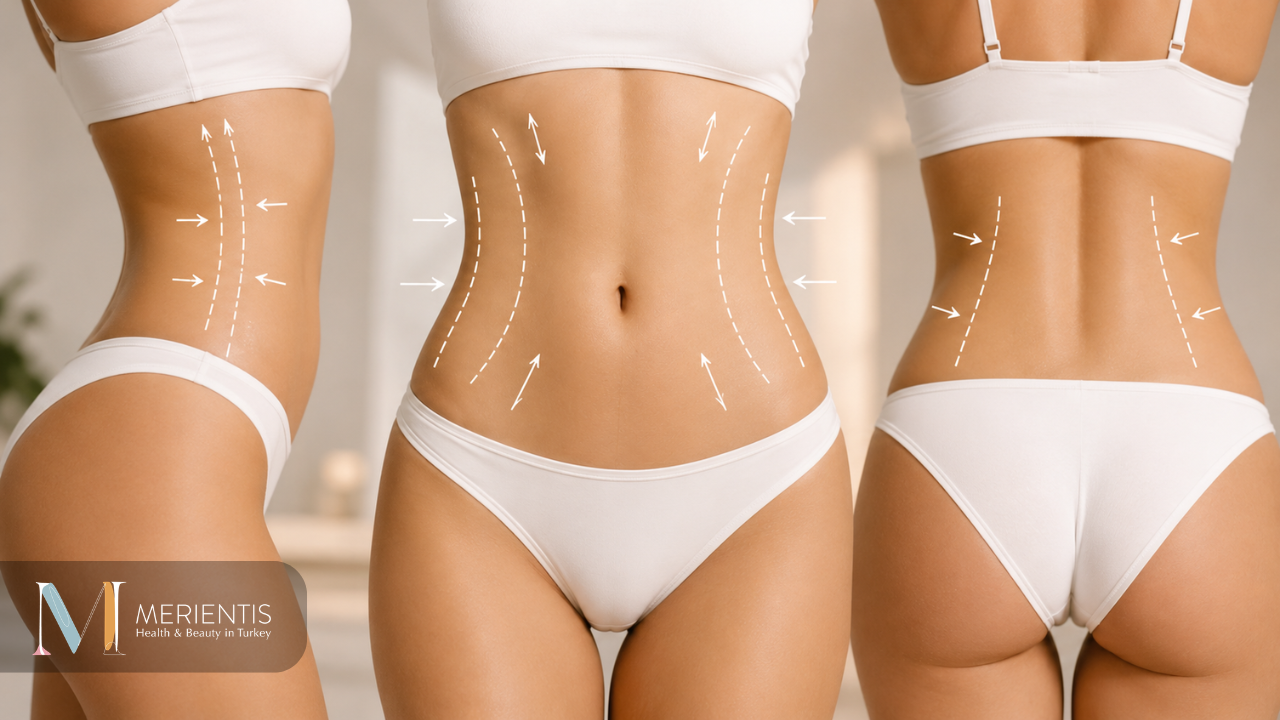
“Melting only the belly is not enough; shaping the waist is an art.”
This sentence explains the main idea behind 360 degree liposuction better than any technical description. Many people think body contouring is only about removing fat from the front of the abdomen. They look in the mirror, hold the lower belly and say, “If this area goes away, everything will look better.”
But the body is not viewed only from the front.
The waist, back, flanks, lower abdomen and side curves all work together to create the body silhouette. A flat-looking abdomen may still appear wide if the waist and back are not evaluated. A slimmer belly may not create the desired hourglass effect if the side body remains full. This is why 360 degree liposuction is discussed as a more holistic body contouring approach.
At Merientis Health in Istanbul, Turkey, 360 degree liposuction should be understood as body shaping, not weight loss. The aim is not simply to remove fat from one area. The aim is to evaluate the torso as a complete three-dimensional structure and plan contouring around the abdomen, waist, flanks and back.
Because the waist is not made from the front alone. It is created from every angle.
What Is 360 Degree Liposuction?
360 degree liposuction is a body contouring approach that focuses on the trunk circumferentially. In simpler words, it evaluates the front, sides and back of the midsection together.
Traditional liposuction may focus on one specific area, such as the abdomen. 360 degree liposuction looks at the abdomen, waist, flanks and back as connected zones. This allows the surgeon to plan a more balanced body contour instead of creating an isolated change in one region.
The term “360 degree” does not mean that every patient receives the same procedure in every area. It means the body is assessed from all angles. Some patients may need more work around the flanks. Others may have fullness in the lower back. Some may have abdominal fat but also side-waist fullness that affects the final silhouette.
The key idea is proportion. Removing fat from the belly alone may reduce volume, but contouring the surrounding areas can help create a more harmonious transition between the waist, abdomen and back.
360 Liposuction Is Not a Weight Loss Procedure
Before talking about waist contouring, one point must be made clearly: 360 degree liposuction is not a weight loss method.
Liposuction does not replace diet, exercise, metabolic health management or obesity treatment. It is designed to reduce localized fat deposits and improve body contour in suitable patients. The change is usually seen more in shape, clothing fit and body proportions than in dramatic scale weight reduction.
This distinction matters because many patients ask, “How many kilos will I lose?” But 360 degree liposuction is not mainly about the number on the scale. It is about what the body looks like from the front, side and back.
A better question would be: “Can my waist, abdomen and back contour be shaped more harmoniously?”
At Merientis Health in Istanbul, Turkey, this expectation should be explained before surgery. The healthiest candidate is usually someone with relatively stable weight, localized fat deposits and realistic contouring goals.
Why Belly Fat Alone Is Not the Whole Story
Many people focus only on the belly because it is the most visible area in the mirror. But the abdominal contour does not exist alone. The side waist and lower back influence how slim or wide the body appears.
For example, a patient may have liposuction only on the front abdomen. The lower belly becomes flatter, but the waist still appears thick from the front because the flanks were not addressed. From the back, the body may still have fullness around the bra line, lower back or side waist.
This can create an incomplete appearance. The abdomen may look improved, but the overall body silhouette may not feel as refined as expected.
That is why 360 degree planning can be valuable in selected patients. The surgeon considers how each area connects to the next. The lower abdomen connects to the pubic area and hips. The flanks connect to the waist and lower back. The upper back connects to the bra line and side body.
Body contouring is not only fat removal. It is visual architecture.
Why Waist Contouring Is Considered an Art
Waist contouring requires more than simply reducing volume. The surgeon must understand natural curves, shadows, proportions and transitions. A waist that looks too straight may not create definition. A waist that is over-treated may look unnatural or uneven.
The goal is not to carve the body aggressively. The goal is to create a smoother and more proportionate contour that fits the patient’s anatomy.
A beautiful waist contour depends on several factors:
The width of the rib cage
The position of the pelvis
The natural waistline
The amount of flank fat
The lower back contour
Skin elasticity
Muscle tone
Overall body proportions
This is why two patients with similar weight may need completely different plans. One may benefit from flank-focused contouring. Another may need lower back shaping. Another may require abdominal liposuction combined with another body contouring procedure if loose skin is present.
Waist shaping is personal. It should not be copied from social media photos.
Abdomen, Waist and Back: Why They Must Be Evaluated Together
The torso is a continuous structure. If only one part is treated, untreated areas can become more noticeable. This does not mean every patient needs liposuction everywhere, but the evaluation should be complete.
The abdomen affects the front view. The flanks affect the front and side views. The lower back affects the back view and waist transition. The upper back can influence how clothing fits, especially around bras, dresses and fitted tops.
When these regions are assessed together, the plan becomes more balanced. Instead of asking, “Where is the most fat?” the surgeon asks, “Which areas are disturbing the natural contour?”
This difference is important. Liposuction is not a race to remove the maximum amount of fat. Removing too much from the wrong area can create irregularities, loose skin or an unnatural transition.
Good 360 degree liposuction respects the body’s natural lines.
Who May Be a Suitable Candidate for 360 Degree Liposuction?
A suitable candidate may be someone with localized fat around the abdomen, flanks, waist or back despite stable weight and lifestyle habits. The person should be in good general health and have realistic expectations about what liposuction can and cannot do.
Skin quality is very important. If the skin has good elasticity, it may adapt better after fat reduction. If there is significant loose skin, liposuction alone may not create the desired result.
Patients who have had pregnancy, major weight changes or abdominal skin laxity may need a more detailed evaluation. In some cases, a tummy tuck or other body contouring procedure may be more appropriate than liposuction alone.
360 degree liposuction may be considered for patients who want contour improvement rather than weight loss. The best candidates usually understand that the procedure shapes the body; it does not replace healthy living.
Who May Not Be Suitable?
360 degree liposuction may not be suitable for patients whose main goal is significant weight loss. It is also not ideal for people with severe skin laxity, uncontrolled medical conditions, unstable weight or unrealistic expectations.
If someone expects liposuction to remove all fat, tighten all loose skin, create a perfect hourglass figure or permanently prevent weight gain, the expectation may not be medically realistic.
It may also not be appropriate when the fullness is caused mainly by visceral fat. Visceral fat is located deep inside the abdomen around internal organs. Liposuction removes subcutaneous fat, which is the fat under the skin. It cannot remove deep internal fat.
This is why a medical evaluation is essential. A protruding abdomen may be caused by subcutaneous fat, visceral fat, muscle separation, bloating, posture or loose skin. The correct plan depends on the actual cause.
What Is the Difference Between 360 Liposuction and Regular Liposuction?
Regular liposuction may target one or more isolated areas. For example, only the lower abdomen or only the flanks may be treated. This can be appropriate for selected patients.
360 degree liposuction, on the other hand, is based on a circumferential approach. The surgeon evaluates the body around the entire midsection. The abdomen, waist, flanks and back are considered together.
This does not necessarily mean more aggressive surgery. It means more strategic planning.
A patient may have a small amount of fat removed from several connected areas rather than a larger amount from one area only. This can sometimes create a more balanced silhouette.
The difference is not just technical. It is artistic. Regular liposuction may answer the question, “Where is the fat?” 360 degree liposuction asks, “How should the body flow from one area to another?”
Does 360 Liposuction Create an Hourglass Shape?
360 degree liposuction may help improve waist definition in suitable patients, but it should not be presented as a guaranteed hourglass procedure. Body shape depends on bone structure, rib cage width, pelvis width, muscle tone, fat distribution and skin quality.
A patient with naturally narrow hips and a wide rib cage may not achieve the same waist-to-hip ratio as someone with a different skeletal structure. Liposuction can reduce selected fat deposits, but it cannot change the bones.
In some patients, waist contouring can create a more defined transition between the abdomen, flanks and back. In others, the change may be more subtle.
The most responsible goal is not “perfect hourglass.” It is better body proportion within the patient’s natural anatomy.
At Merientis Health in Istanbul, Turkey, the consultation should focus on what is realistic for that body, not what is trending online.
Why the Back Matters in Waist Slimming
The back is often underestimated in body contouring. Many patients focus on the belly and forget that the waist is also seen from behind.
Back fat can make the waistline appear wider. Fullness around the bra line, lower back or flanks can affect how dresses, swimwear and fitted clothing look. Even if the abdomen is treated, untreated back fullness can reduce the visual impact of waist contouring.
This is why back evaluation is important in 360 degree liposuction. The lower back and flank transition can influence the overall silhouette dramatically.
However, back liposuction also requires careful technique. The back skin and fat layers may behave differently from the abdomen. The goal should be smooth contouring, not over-removal.
A natural back contour can make the waist look more refined without looking surgically exaggerated.
Why the Flanks Are Key to Waist Definition
The flanks, commonly called love handles, are one of the most important areas in waist contouring. They sit on the sides of the body and affect both the front and back silhouette.
A person may have a relatively flat abdomen but still feel wide because the flanks create side fullness. Reducing this area in suitable patients may help the waist appear more defined.
But flank liposuction must be planned carefully. Over-treatment can create dents or unnatural transitions. Under-treatment may leave the waist insufficiently shaped.
The surgeon must evaluate how the flanks connect to the hips, abdomen and lower back. A good waist contour should look smooth from every angle, not only in a posed front-view photo.
What About the Lower Abdomen?
The lower abdomen is one of the most common areas patients want to treat. It may hold stubborn fat after pregnancy, weight changes or lifestyle efforts. But not every lower abdomen concern is caused by fat alone.
Loose skin, muscle separation, C-section scar tethering, posture and deep abdominal fullness can all affect the lower belly. If the main issue is loose skin, liposuction alone may not be enough. In some cases, abdominoplasty may be discussed.
When the lower abdomen is suitable for liposuction, it can be included as part of 360 degree contouring. The goal is to create a smoother front profile while maintaining harmony with the waist and flanks.
A flat abdomen without a shaped waist may still look incomplete. This is why the lower abdomen should be treated as one part of a full contour plan.
Can 360 Liposuction Tighten Loose Skin?
Liposuction does not directly tighten loose skin. It removes fat under the skin. Skin retraction depends on the patient’s skin elasticity.
If the skin is elastic, it may contract better after fat removal. If the skin is loose, stretched or damaged, it may not retract enough. In those cases, removing fat can sometimes make skin laxity more visible.
This is particularly important after pregnancy or major weight loss. A patient may think the abdomen is full because of fat, but the real issue may be excess skin or abdominal wall laxity.
At Merientis Health in Istanbul, Turkey, skin quality should be evaluated carefully before planning 360 degree liposuction. If the patient needs skin removal, a different procedure may provide a more appropriate result.
How Is 360 Degree Liposuction Planned?
Planning begins with a full body assessment. The surgeon evaluates the patient from the front, side and back. Fat distribution, skin quality, waist position, hip ratio, abdominal wall condition and natural body curves are assessed.
Preoperative marking is usually performed while the patient is standing. This is important because body contours change when lying down. The surgeon marks the areas of fullness and the intended contour transitions.
The surgical plan may include different levels of fat reduction in different zones. The abdomen may need one approach, the flanks another and the back another. The aim is balance.
The plan should also include recovery expectations, compression garment use, swelling timeline, activity restrictions and follow-up care.
Good planning is what separates contouring from simple fat removal.
What Is Recovery Like After 360 Liposuction?
Recovery varies depending on the extent of the procedure, the patient’s health, the treated areas and the surgeon’s protocol. Swelling, bruising, soreness, tightness, numbness or temporary firmness can occur.
Because 360 degree liposuction involves multiple areas around the torso, patients may feel discomfort when sitting, standing, turning or sleeping during the early period. Compression garments are often recommended according to the surgeon’s instructions.
The body does not show the final contour immediately. Swelling can temporarily hide the result. Some areas may look uneven while healing. This does not always mean the final result will be uneven.
The contour usually becomes clearer as swelling decreases and tissues settle. Patience is important. The healing process is part of the result.
Why Compression Garments Matter
Compression garments may help support the treated areas, manage swelling and assist the tissues as they heal. They are commonly used after liposuction, but the exact type and duration should be determined by the surgeon.
Some patients think tighter compression means better results. This is not necessarily true. Excessively tight garments can be uncomfortable and may create pressure issues.
Others want to stop wearing the garment early because it feels restrictive. That may also not be ideal if the surgeon has recommended a specific timeline.
The best approach is to follow medical guidance. Compression is not just a garment; it is part of the postoperative plan.
When Will the Waist Look Slimmer?
Many patients want to see the waist immediately after surgery. Some early change may be visible, but swelling can make the body look larger or uneven at first.
The waist contour usually becomes more noticeable as swelling decreases. This can take weeks to months. The timeline varies from patient to patient.
It is common for one side to look more swollen than the other during recovery. The back may feel firm. The flanks may remain sensitive. The abdomen may feel tight. These changes are part of tissue healing.
Final evaluation should not be made too early. Body contouring results mature gradually.
Can Fat Come Back After 360 Liposuction?
Liposuction reduces fat cells in treated areas, but it does not prevent future weight gain. If the patient gains weight after surgery, remaining fat cells can enlarge, and fat can accumulate in untreated or treated areas.
This means 360 degree liposuction is not a permanent protection against lifestyle-related weight changes. Nutrition, exercise, sleep, stress management and weight stability still matter.
The best long-term results are usually supported by consistent lifestyle habits. Liposuction can shape the body, but the patient helps maintain the result.
This is why the procedure should not be seen as a shortcut that replaces self-care. It is a contouring tool, not a metabolic solution.
Can 360 Liposuction Be Combined with Fat Transfer?
In some body contouring plans, fat removed through liposuction may be processed and transferred to other areas, such as the buttocks or hip dips. This is sometimes discussed in body shaping procedures.
However, fat transfer is a separate surgical decision with its own risks, limitations and suitability criteria. Not every patient is a candidate. Not every liposuction case should include fat transfer.
The priority should always be safety and anatomical appropriateness. If fat transfer is considered, it must be discussed clearly during consultation.
For this blog topic, the main focus remains 360 degree liposuction and waist contouring. Any combined procedure should be planned individually.
Common Misconceptions About 360 Degree Liposuction
One common misconception is that 360 liposuction is a weight loss surgery. It is not. It is body contouring.
Another misconception is that it creates the same waist shape in every patient. The final contour depends on anatomy, bone structure, skin elasticity and fat distribution.
A third misconception is that only the belly matters. In reality, the back and flanks can strongly influence waist definition.
Some people also think more fat removal always means a better result. This is wrong. Over-removal can create contour irregularities and unnatural shadows.
The best result is usually not the most aggressive one. It is the most balanced one.
Why 360 Liposuction Is Frequently Researched in Istanbul, Turkey
Istanbul, Turkey is widely researched for plastic surgery and medical tourism. Body contouring procedures, including liposuction, are among the most commonly searched treatments by local and international patients.
Many patients look for waist slimming, abdominal contouring and a more balanced body silhouette. 360 degree liposuction is often researched because it promises a more complete approach than treating only one area.
However, patients should be careful with exaggerated claims. Terms like “snatched waist” or “instant hourglass” can create unrealistic expectations. A medical consultation should replace trend-based thinking with anatomical planning.
At Merientis Health in Istanbul, Turkey, 360 degree liposuction should be discussed with realistic goals, safety awareness and personalized assessment.
What Questions Should You Ask Before 360 Liposuction?
Before surgery, patients should ask practical and honest questions. These help clarify whether the procedure is suitable.
Useful questions include:
Am I a suitable candidate for 360 degree liposuction?
Is my abdominal fullness caused by subcutaneous fat, loose skin or visceral fat?
Will my back and flanks be included in the plan?
How much waist definition is realistic for my anatomy?
Do I have enough skin elasticity for liposuction alone?
Would I need a tummy tuck instead or in combination?
How long will swelling last?
What compression garment will I need?
When can I return to work, exercise and travel?
How can I maintain the result long term?
These questions make the consultation more productive. They also help prevent disappointment caused by unrealistic expectations.
How Should Expectations Be Managed?
Expectation management is essential in 360 degree liposuction. The patient may want a smaller waist, smoother abdomen and more defined back line. These goals may be reasonable in selected patients, but the degree of change varies.
The body has anatomical limits. Liposuction cannot change bone structure, remove visceral fat, tighten severe loose skin or create the exact same silhouette as another person.
The healthiest expectation is improvement in contour, not perfection. The goal is a more balanced body shape that fits the patient’s natural proportions.
At Merientis Health in Istanbul, Turkey, honest communication should guide the process. A patient should understand what is possible, what is limited and what depends on healing.
Conclusion: Waist Contouring Is More Than Belly Fat Removal
360 degree liposuction is based on a simple but powerful idea: the waist is shaped from every angle. Treating only the belly may not be enough if the flanks, back and side body are not considered.
“Sadece göbeği eritmek yetmez, beli inceltmek sanattır” translates perfectly into the philosophy of modern body contouring. It is not only about removing fat. It is about creating smoother transitions, better proportions and a more harmonious silhouette.
At Merientis Health in Istanbul, Turkey, 360 degree liposuction should be planned as a personalized contouring procedure, not a weight loss shortcut. The abdomen, waist, flanks and back must be evaluated together to determine what is realistic and medically appropriate.
A slimmer-looking waist is not created by one isolated move. It is created through careful analysis, balanced fat reduction, respect for anatomy and proper healing.
If you are considering 360 degree liposuction, the first question should not be “How much fat can be removed?” A better question is: “How can my body be shaped safely and naturally from every angle?”
Frequently Asked Questions
What is 360 degree liposuction?
360 degree liposuction is a body contouring approach that evaluates and treats the midsection circumferentially. It may include the abdomen, waist, flanks and back depending on the patient’s anatomy and goals.
Is 360 liposuction a weight loss procedure?
No. 360 degree liposuction is not a weight loss method. It is designed to reduce localized fat deposits and improve body contour in suitable patients.
Does 360 liposuction create a smaller waist?
It may help improve waist definition in suitable patients by addressing the abdomen, flanks and back together. However, the degree of waist slimming depends on anatomy, skin quality and fat distribution.
Can 360 liposuction create an hourglass body?
It may support a more defined silhouette in selected patients, but it cannot change bone structure or guarantee an hourglass shape. Expectations should be realistic.
What areas are treated in 360 liposuction?
Commonly evaluated areas include the abdomen, flanks, waist, lower back and sometimes upper back. The exact plan is personalized.
Can 360 liposuction tighten loose skin?
No. Liposuction does not directly tighten loose skin. Skin retraction depends on elasticity. If loose skin is significant, other procedures may be discussed.
Is back liposuction important for waist contouring?
Yes, in many patients the back and flanks strongly influence waist definition. Treating the abdomen alone may not create a complete silhouette.
How long does swelling last after 360 liposuction?
Swelling varies from person to person. It can take weeks to months for the contour to become clearer. Final evaluation should not be made too early.
Can fat return after 360 liposuction?
Liposuction reduces fat cells in treated areas, but future weight gain is still possible. Maintaining stable weight and healthy habits helps preserve results.
Why is 360 liposuction popular in Istanbul, Turkey?
Istanbul, Turkey is frequently researched for plastic surgery and medical tourism. Many patients explore 360 degree liposuction for body contouring, waist definition and a more balanced silhouette.