“Can someone tell it is silicone when they touch it?”
This is one of the most personal questions women ask before breast augmentation surgery. And honestly, it is a very understandable concern. Breast augmentation is not only about how the breasts look in a mirror, in a dress or in photos. It is also about how they feel in daily life, in movement, in close contact and in the person’s own body perception.
Many women want fuller, more balanced or more proportionate breasts, but they do not want an artificial feeling. They may wonder whether implants feel hard, obvious, cold, separate from the body or noticeably different from natural breast tissue.
The short answer is this: modern silicone breast implants, especially soft-touch cohesive gel implants, can feel much more natural than many people imagine. However, the final feel is not determined by the implant alone. It depends on implant type, size, placement, natural breast tissue, skin quality, body structure, surgical planning and healing.
At Merientis Health in Istanbul, Turkey, breast augmentation planning should never focus only on volume. A natural-looking and natural-feeling result requires a personalized evaluation. The question is not simply “Which implant is soft?” The real question is: “Which implant, size, profile and placement are suitable for this body?”
What Does “Natural Feel” Mean in Breast Augmentation?
When patients say they want a natural feel, they may mean different things. Some mean the breast should feel soft to touch. Some mean the implant should not be easily felt under the skin. Others mean the breast should move naturally when walking, lying down or wearing clothing.
For some patients, “natural” means subtle. For others, it means a fuller but still soft breast contour. This is why the consultation process matters so much. The surgeon needs to understand what the patient means by natural before discussing implant options.
A natural breast is not perfectly firm or perfectly round. It has softness, movement and tissue variation. It changes slightly with body position. It may feel different in the upper pole, lower pole and side areas.
Breast implants can support volume and shape, but they are not the same as biological breast tissue. The goal is not to deny this difference. The goal is to choose and place the implant in a way that feels harmonious with the patient’s own tissues.
What Are Soft-Touch Breast Implants?
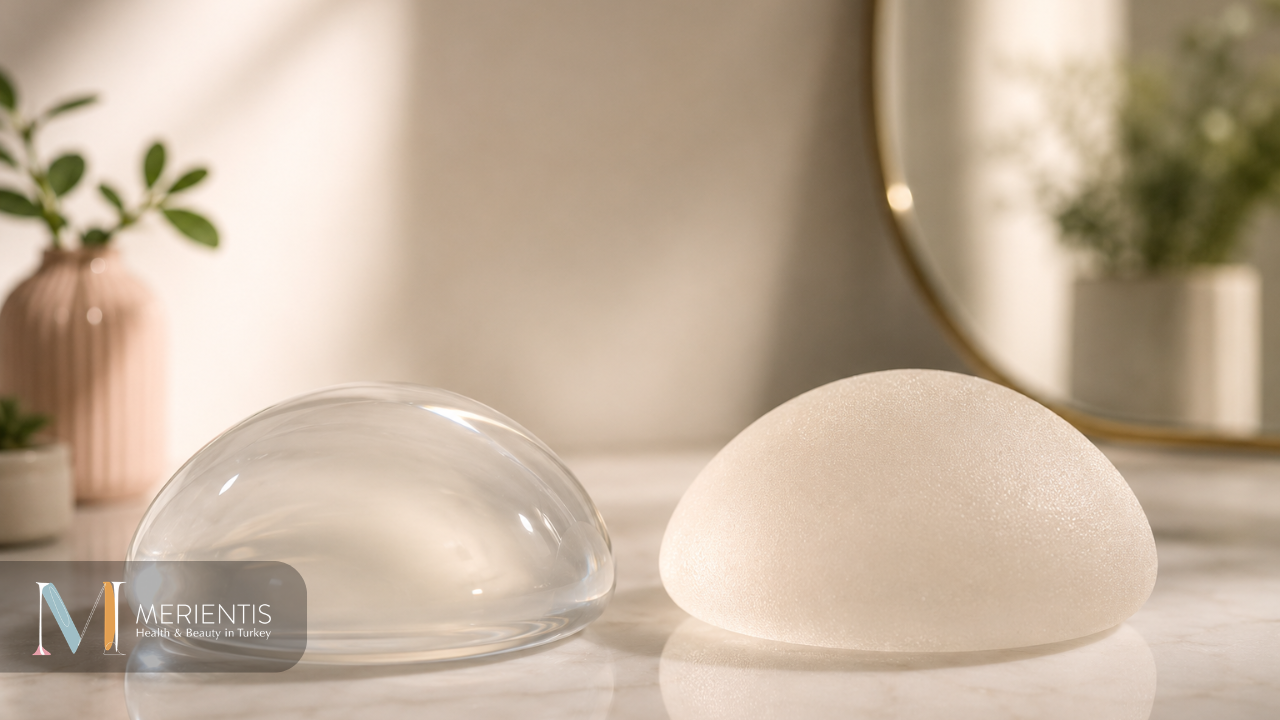
Soft-touch breast implants generally refer to silicone gel implants designed to feel softer and closer to natural breast tissue compared to older or firmer implant types. These implants usually contain cohesive silicone gel, meaning the gel is designed to hold together while still allowing a soft feel.
The term “soft touch” can sound like a marketing phrase, but the idea behind it is simple. Patients want implants that do not feel overly hard, rigid or unnatural. Modern silicone gel technology aims to provide a balance between softness, shape stability and tissue-like consistency.
However, not every soft implant is right for every patient. A very soft implant may feel pleasant, but implant selection also needs to consider body frame, skin thickness, breast tissue coverage, desired shape, implant profile and long-term support.
At Merientis Health in Istanbul, Turkey, choosing an implant should be part of a complete breast analysis. The softest implant is not automatically the best implant. The most suitable implant is the one that matches the patient’s anatomy and aesthetic goals responsibly.
Silicone vs. Saline: Which Feels More Natural?
In general, many patients and surgeons consider silicone gel implants to feel more similar to natural breast tissue than saline implants. Saline implants are filled with sterile salt water, while silicone implants contain a cohesive silicone gel.
Saline implants can be appropriate in selected cases, but they may feel firmer or show more rippling in some patients, especially when tissue coverage is thin. Silicone implants are often preferred by patients who prioritize a softer and more natural breast feel.
That said, the difference is not only about the implant filling. A silicone implant can still feel obvious if it is too large for the body, placed in a patient with very thin tissue or positioned in a way that does not suit the anatomy.
Likewise, a well-selected implant with good tissue coverage may feel more natural because the patient’s own breast and soft tissue help blend the implant into the body.
So the better question is not only “silicone or saline?” It is “Which implant choice will create the most natural look and feel for my body?”
Can Someone Feel the Implant by Touching?
Sometimes yes, sometimes no. It depends on several factors.
If the patient has enough natural breast tissue and soft tissue coverage, the implant may be less noticeable to touch. If the implant is placed under the muscle or in a dual-plane position, this may also provide additional coverage in selected patients.
However, in very thin patients or those with limited breast tissue, the edges of the implant may be more palpable, especially in the lower outer part of the breast. This does not always mean the result is bad; it simply reflects the relationship between implant and tissue coverage.
Implant size also matters. A larger implant stretches the skin and tissues more. If the implant is too large for the patient’s body, it may feel tighter, firmer or more obvious. Choosing a size that respects the chest width and tissue capacity can help create a softer and more balanced feel.
So, can someone always tell it is silicone by touch? No. But can it ever be felt in some patients? Yes. Honest expectation is important.
Why Tissue Coverage Is So Important
Natural tissue coverage is one of the most important factors affecting implant feel. Think of the implant as the structure inside and the patient’s tissue as the layer that softens and blends that structure.
If there is enough breast tissue and subcutaneous fat, the implant may feel more integrated. If the tissues are thin, the implant may be easier to feel. This is especially true around the lower and outer breast, where tissue coverage may naturally be less.
This is why two patients with the same implant may have different results. One may say, “It feels very natural,” while another may notice the implant edge in certain positions. The implant is the same, but the body is different.
During consultation, the surgeon evaluates breast tissue thickness, skin elasticity, chest shape, breast base width and tissue quality. These details help determine implant type, size and placement.
At Merientis Health in Istanbul, Turkey, this anatomical evaluation is essential for creating realistic expectations about both appearance and touch.
Does Implant Placement Affect How Natural It Feels?
Yes, implant placement can affect both appearance and feel. Breast implants may be placed above the muscle, under the muscle or in a dual-plane position depending on the patient’s anatomy and surgical plan.
Subglandular placement means the implant is placed above the chest muscle and under the breast tissue. This may be suitable for some patients with enough natural tissue coverage. However, in thin patients, the implant may be more noticeable.
Submuscular or dual-plane placement provides additional coverage over the upper part of the implant. This can help create a softer transition in selected patients, especially when natural breast tissue is limited.
However, there is no single best placement for everyone. Each technique has advantages and considerations. The right choice depends on body structure, tissue coverage, implant size, activity level, breast shape and the surgeon’s assessment.
A natural feel comes from harmony between implant and body, not from one universal technique.
Does Implant Size Affect Natural Feel?
Absolutely. Implant size is one of the biggest factors in whether the result feels natural. A size that is proportionate to the patient’s chest, skin and breast tissue is more likely to feel balanced.
When an implant is too large for the available tissue, the breast may feel tight or overly firm. The skin may be stretched more, and the implant may become more noticeable. This can also affect the overall look, making the breast appear less natural.
Many patients come to consultation with a specific cup size in mind. But cup size is not a precise medical measurement. Bra sizes vary between brands, countries and styles. A better approach is to evaluate chest width, breast base, tissue quality and desired proportion.
The goal should not be “as large as possible.” The goal should be “as suitable as possible.”
In breast augmentation, natural feel often begins with not forcing the body beyond its tissue limits.
Do Teardrop or Round Implants Feel Different?
Implant shape can influence appearance, but feel is more strongly affected by implant gel, size, placement and tissue coverage. Both round and anatomical implants can feel natural in suitable patients.
Round implants are commonly used and can create different degrees of fullness depending on profile and placement. Anatomical or teardrop implants are designed to mimic a sloped breast shape, with more fullness toward the lower part.
However, implant shape alone does not guarantee a natural result. A round implant can look and feel natural if chosen appropriately. A teardrop implant can look less natural if it does not suit the anatomy or if complications occur.
The decision should not be based only on trends or online opinions. The best implant shape depends on the patient’s chest structure, breast tissue, desired upper pole fullness and surgical plan.
What Role Does Skin Quality Play?
Skin quality affects how the breast implant settles and how the breast feels over time. Elastic, healthy skin may adapt better to the implant. Thin, stretched or loose skin may behave differently.
Patients who have experienced pregnancy, breastfeeding, weight loss or aging may have changes in skin elasticity. In some cases, breast augmentation alone may not be enough. If sagging is significant, a breast lift may need to be discussed.
If the skin is very tight, the breasts may feel firm in the early period after surgery. If the skin is loose, the implant may not create the desired lifted shape without additional procedures.
Skin is not just a cover. It is part of the final result. It influences softness, shape, support and how natural the implant feels to the patient.
Does the Implant Feel Hard Right After Surgery?
It can. In the early recovery period, breasts may feel tight, swollen, firm or high on the chest. This is usually related to swelling, tissue tension and the body’s healing response.
Patients sometimes worry during the first weeks and ask, “Will they always feel this hard?” In many cases, the answer is no. As swelling decreases and tissues relax, the breasts may gradually soften and settle.
This process is sometimes described as “drop and fluff,” although the timing varies from person to person. The implant settles into a more natural position, and the surrounding tissues adapt.
However, patients should not compare early recovery with the final result. The feel of the breast at two weeks is not the same as the feel after several months.
Patience is part of breast augmentation recovery.
What Is Capsular Contracture and How Can It Affect Feel?
After any breast implant surgery, the body forms a natural scar tissue capsule around the implant. This is a normal healing response. In most patients, this capsule remains soft.
Capsular contracture occurs when this capsule becomes tighter or thicker than expected. When that happens, the breast may feel firmer, look distorted or become uncomfortable in some cases.
Capsular contracture is one of the reasons why a breast implant that initially felt soft may later feel harder. It does not happen to every patient, but it is an important risk to understand before surgery.
Prevention and management depend on multiple factors, including surgical technique, implant selection, pocket creation, infection prevention, patient biology and follow-up care.
A responsible consultation should discuss this risk clearly. Natural feel is not only about choosing a soft implant on surgery day. It is also about long-term healing and tissue response.
Can Implants Feel Natural During Movement?
A natural-feeling breast is not only about touch. Movement matters too. Patients often ask whether implants move naturally when walking, exercising or lying down.
The answer depends on implant size, placement, tissue coverage, skin quality and healing. A proportionate implant placed in a suitable pocket may move more naturally with the body. A very large or tight implant may feel less mobile.
In the early recovery period, movement may feel limited because the tissues are healing. The breasts may feel firm or high. Over time, as tissues settle, movement usually becomes more natural.
Supportive bras may be recommended during recovery and sometimes during exercise afterward. Even natural breasts need support during high-impact activity, so implants do not eliminate the need for proper support.
Can Breast Implants Feel Natural in Intimate Contact?
This is a sensitive but very real concern. Many patients wonder whether their partner will notice the implant or whether the breast will feel artificial in intimate moments.
The answer varies. In patients with good tissue coverage, appropriate implant size and soft silicone implants, the breast may feel quite natural. In thinner patients or with larger implants, the implant may be more noticeable.
It is also important to remember that personal perception matters. Some patients feel their breasts are natural because they feel integrated with their body. Others may need more time to emotionally adjust, even if the surgical result is good.
Intimacy after breast augmentation is not only physical. It also involves confidence, comfort and body acceptance. Healing is both external and internal in a way.
Can Very Thin Patients Have Natural-Feeling Implants?
Thin patients can have breast augmentation, but natural feel may be more challenging if there is limited tissue coverage. The implant may be easier to feel at the edges, especially if a large size is chosen.
For thin patients, careful implant selection is especially important. A moderate size, suitable profile and appropriate placement may help create a softer, more balanced result. In some cases, fat grafting may be discussed as an additional option to improve soft tissue coverage, depending on the patient’s anatomy.
The goal should be subtle harmony, not excessive volume. When tissue coverage is limited, respecting the body’s boundaries becomes even more important.
A thin patient should not be promised that implants will be completely undetectable by touch. Instead, the surgeon should explain what can realistically be achieved.
Do Implants Feel Different Over Time?
Yes, breast implants may feel different over time. In the first weeks, they may feel firmer due to swelling and tight tissues. Over several months, they often feel softer as healing progresses.
Long-term changes can also occur. Aging, weight fluctuations, pregnancy, breastfeeding, skin changes and capsule formation can all influence how the breast feels. The implant itself may remain stable, but the tissues around it change with life.
This is why breast augmentation should not be viewed as a one-time aesthetic decision disconnected from the future. It requires long-term awareness, follow-up and realistic understanding.
Breast implants are not lifetime devices for every patient. Future monitoring or additional surgery may be needed depending on implant condition, body changes or patient preference.
Is “Undetectable Silicone” a Realistic Goal?
This depends on what is meant by undetectable. In some patients, implants can look and feel very natural. In others, especially those with thin tissue or larger implants, they may be more noticeable.
The word “undetectable” can create unrealistic pressure. A more responsible goal is a soft, proportionate, well-integrated breast appearance and feel. The implant should match the body as much as possible, but surgery cannot guarantee that no one will ever detect it.
A patient-centered consultation should be honest. It should say: “We can aim for the most natural feel possible for your anatomy.” That is different from saying: “No one will ever know.”
At Merientis Health in Istanbul, Turkey, expectation management is part of safe and ethical breast augmentation planning.
What Can Patients Do to Support a Softer Result?
Patients can support recovery by following postoperative instructions carefully. This may include wearing the recommended bra, avoiding early strenuous activity, attending follow-up visits and following wound care guidance.
Some surgeons may recommend massage or implant displacement exercises in selected cases, while others may not. This depends on implant type, pocket placement and surgical preference. Patients should not begin massage unless their surgeon specifically recommends it.
Smoking should be avoided because it can affect healing. Weight stability may also help maintain the breast shape over time.
The surgeon creates the surgical plan, but the patient’s recovery behavior also matters. Healing is a partnership.
Why Implant Choice Should Be Personalized
Breast implants differ in size, profile, fill, surface, shape and firmness. This variety exists because patients are different. A choice that works beautifully for one person may not suit another.
A patient with wide chest anatomy may need a different implant base than someone with a narrow chest. A patient with existing breast volume may need less implant projection than someone with very little natural tissue. A patient seeking subtle fullness may need a different plan than someone seeking more noticeable enhancement.
This is why choosing implants only from photos can be misleading. Photos do not show tissue thickness, chest width, skin elasticity or how the implant feels.
A personalized approach looks at the whole body, not just the desired cup size.
Breast Augmentation in Istanbul, Turkey: Why Patients Ask About Natural Feel
Istanbul, Turkey is widely researched for plastic surgery and medical tourism. Breast augmentation is one of the procedures many local and international patients explore, and “natural feel” is one of the most common concerns.
Patients traveling to Istanbul often want clear answers before making a decision. They want to know whether implants will feel soft, whether silicone will be obvious, whether the result will look natural in clothing and how long it takes for the breasts to settle.
At Merientis Health in Istanbul, Turkey, breast augmentation should be discussed through realistic, anatomy-based planning. The implant should not be selected only for size. It should be chosen according to body proportions, tissue coverage, lifestyle, healing expectations and long-term comfort.
A natural-feeling result begins before surgery, during consultation.
What Questions Should You Ask Before Breast Augmentation?
Patients should feel comfortable asking detailed questions about implant feel. These questions are not superficial. They are central to satisfaction.
Useful questions include:
Which implant type may feel most natural for my body?
Do I have enough tissue coverage?
Will the implant edges be easy to feel?
Should the implant be placed under or over the muscle?
What size is realistic for a natural feel?
How long will the breasts feel firm after surgery?
Can capsular contracture affect softness?
Will implants move naturally after healing?
How might pregnancy or weight changes affect the result?
What follow-up will I need after surgery?
The more clearly these questions are answered, the more realistic the decision becomes.
Conclusion: Natural Feel Depends on More Than the Implant
Modern soft-touch silicone implants can feel much more natural than many patients expect. In suitable patients, with appropriate implant selection and enough tissue coverage, the breast can feel soft, balanced and well integrated with the body.
However, it is not responsible to promise that silicone will never be detectable by touch. The final feel depends on anatomy, implant type, size, placement, tissue coverage, healing and long-term capsule behavior.
At Merientis Health in Istanbul, Turkey, breast augmentation planning should focus on personalized harmony rather than standard implant selection. The best result is not simply the largest implant or the softest implant. It is the implant that suits the patient’s body, skin, tissue and expectations.
“Can someone tell it is silicone when they touch it?” The honest answer is: sometimes it may be very difficult to tell, and sometimes the implant may be noticeable depending on the body. The goal is to create the most natural look and feel possible for that individual patient.
If natural touch is important to you, this should be discussed openly during consultation. A beautiful breast augmentation result should not only look right. It should also feel right for the person living with it.
Frequently Asked Questions
Do silicone breast implants feel natural?
Modern silicone implants can feel soft and close to natural breast tissue in suitable patients. However, the final feel depends on tissue coverage, implant size, placement, healing and anatomy.
Can someone tell I have implants by touching?
Sometimes implants may be difficult to detect, especially with good tissue coverage and appropriate implant choice. In thin patients or with larger implants, the implant may be more noticeable.
Are soft-touch implants better?
Soft-touch silicone implants may provide a softer feel, but they are not automatically the best choice for everyone. The implant must match the patient’s anatomy and goals.
Do implants feel hard after surgery?
In the early recovery period, breasts may feel tight, firm or swollen. They often soften gradually as swelling decreases and tissues adapt.
Does implant placement affect feel?
Yes. Implant placement can affect how natural the breast feels. Under-muscle or dual-plane placement may provide more coverage in selected patients, while above-muscle placement may suit others.
Can very thin patients get natural-feeling implants?
Thin patients can have breast augmentation, but implant edges may be more noticeable if tissue coverage is limited. Careful size and placement selection is especially important.
Can capsular contracture make implants feel hard?
Yes. Capsular contracture can make the breast feel firmer or distorted in some patients. It is an important risk to discuss before surgery.
Do larger implants feel less natural?
Very large implants can feel tighter or more obvious if they exceed the body’s tissue capacity. A proportionate implant usually supports a more natural feel.
How long does it take for implants to feel natural?
The timeline varies. Many patients notice gradual softening over several months as swelling decreases and tissues settle.
Why do patients choose breast augmentation in Istanbul, Turkey?
Istanbul, Turkey is frequently researched for plastic surgery and medical tourism. Many patients seek personalized breast augmentation planning with attention to natural look, natural feel and body proportion.