“Do you really think a thick-skinned nose can never improve?”
This is one of those questions many people silently carry while researching rhinoplasty. If your nose tip looks rounded, your skin feels oily or dense, your pores are visible, or your nose has what people often describe as a “fleshy” appearance, you may have already heard discouraging comments: “Thick skin is too difficult,” “The tip will never get refined,” “Rhinoplasty does not work well on thick-skinned noses,” or “It will not change much anyway.”
But is that really true?
The answer is not that simple. Thick-skinned noses do require more careful planning, more patience, and a different surgical mindset compared to thin-skinned noses. However, saying that thick-skinned noses “never improve” is not accurate.
In rhinoplasty, the goal is not always to create the smallest or sharpest nose possible. Especially in thick-skinned noses, the aim is usually to create better support, improve balance, refine the overall shape, and help the nose look more harmonious with the face.
At Merientis Health in Istanbul, Turkey, thick-skinned rhinoplasty is approached with this broader understanding. The skin is only one part of the evaluation. Cartilage strength, nasal bone structure, nasal tip support, soft tissue thickness, facial proportions, breathing function, and patient expectations all need to be considered together.
Because rhinoplasty is not simply about reducing the nose. It is about reshaping the nose in a way that respects the person’s anatomy, facial character, and healing process.
What Is a Thick-Skinned Nose?
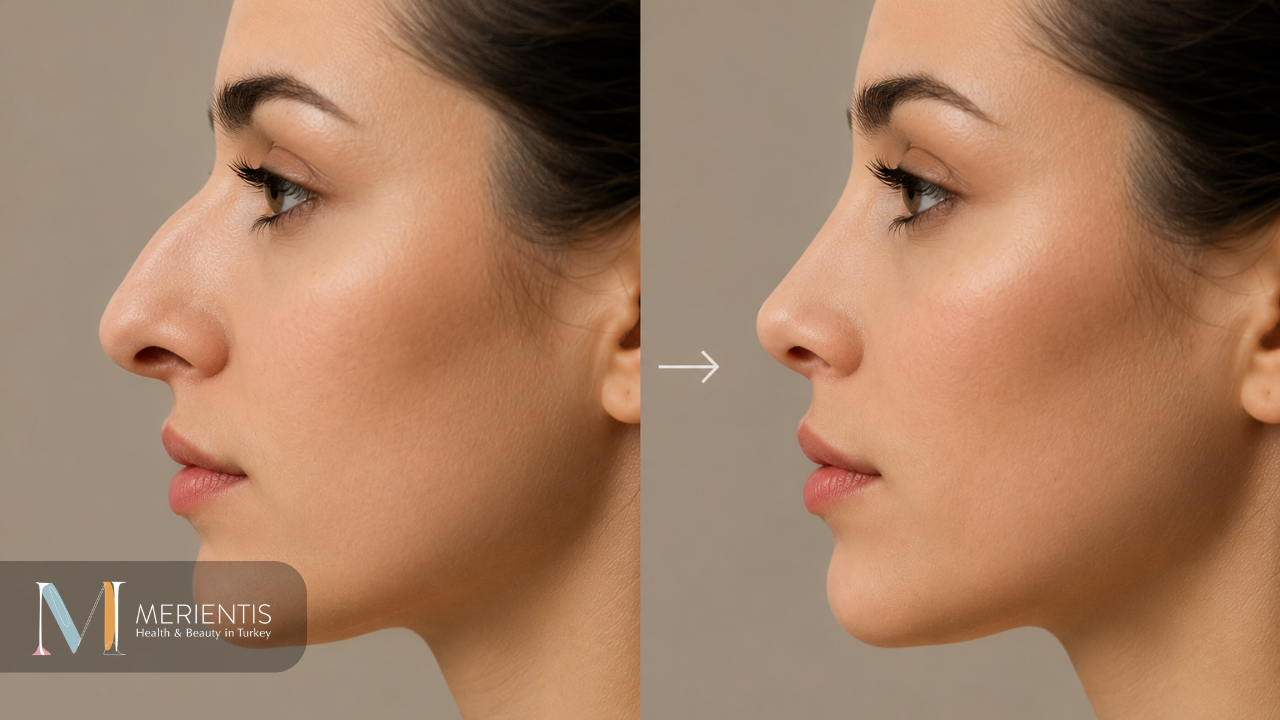
A thick-skinned nose refers to a nasal structure where the skin and soft tissue layer over the cartilage and bone are denser than average. This is often most noticeable around the nasal tip. The tip may look rounder, fuller, wider, or less defined.
Some people have a relatively smooth nasal bridge but a broad and heavy-looking nasal tip. Others may have both a wide nasal structure and thick skin. So, a thick-skinned nose is not one single nose type. It can appear in different forms depending on the person’s anatomy.
A simple analogy may help. Imagine placing a thin fabric over a sculpture. The details underneath are easily visible. Now imagine placing a thicker fabric over the same sculpture. The general shape is still there, but the fine details become softer and less defined.
The same idea applies to rhinoplasty. Even when the surgeon carefully shapes the bone and cartilage underneath, the final external appearance depends heavily on how the skin reflects that structure. Thick skin tends to show details more slowly and more softly.
This is why thick-skinned rhinoplasty requires strategic planning. The surgeon must think not only about how to shape the nasal framework, but also about how the skin is likely to adapt over time.
Are Thick-Skinned Noses Really More Difficult?
Yes, thick-skinned noses can be more challenging from a rhinoplasty planning perspective. But “challenging” does not mean “impossible.” It simply means the process needs more precision, more realistic expectations, and a longer healing timeline.
In thin-skinned noses, even small changes in cartilage or bone may become visible relatively quickly. In thick-skinned noses, the skin can soften or hide some of those details. This is especially true in the nasal tip area, where swelling may last longer.
That is why some patients look in the mirror during the early months and think, “My nose still looks swollen,” or “The tip has not changed enough.” This reaction is very common and understandable. After all, people often spend months or even years thinking about rhinoplasty before finally deciding to go through with it.
But the early healing period is not the right time to judge the final result. The nose continues to change gradually. Swelling decreases, tissues soften, and the skin begins to adapt to the new structure.
In Istanbul, Turkey, thick-skinned noses are commonly discussed during rhinoplasty consultations because this nasal skin type is frequently seen in Turkey and nearby regions. That makes proper patient education especially important before surgery.
Why the Idea “Thick-Skinned Noses Never Improve” Is Wrong
The belief that thick-skinned noses cannot improve usually comes from oversimplified or exaggerated information. Thick-skinned noses do not behave like thin-skinned noses, that part is true. But with appropriate surgical technique, patient selection, realistic planning, and proper follow-up, meaningful improvement may be achieved.
The word “improvement” also needs to be understood correctly. Rhinoplasty is not about turning every nose into the same small, narrow, sharply defined shape. It is about creating better facial harmony within the limits of the person’s own anatomy.
In thick-skinned noses, the nasal tip may be better supported, the overall sense of width may be reduced, the relationship between the bridge and the tip may be improved, and the profile may appear more balanced. However, these changes may not look as sharp or dramatic as they sometimes do in thin-skinned noses.
Is that a bad thing? Not necessarily.
In fact, thick skin can sometimes help create a softer and more natural-looking result. The key is not to chase an overly sharp or artificial appearance. The key is to design a nose that belongs to the face.
Why Does Swelling Last Longer in Thick-Skinned Noses?
Swelling after rhinoplasty is a natural part of healing. During surgery, nasal tissues are reshaped, cartilage and bone may be adjusted, and the soft tissues begin adapting to a new structure. Some degree of swelling is expected.
In thick-skinned noses, the soft tissue layer is denser, especially around the nasal tip. Because of this, swelling may take longer to resolve. The nasal tip may feel firm, round, or fuller than expected during the first months.
This can be emotionally difficult for patients. You may have waited a long time to have rhinoplasty, gone through the decision-making process, and imagined how your nose would look afterward. Naturally, you want to see the result as soon as possible.
But thick-skinned rhinoplasty is not an instant-result process. The nose changes gradually. Sometimes the changes are so subtle from day to day that you may not notice them immediately. Yet when you compare photos from different months, the progress becomes clearer.
At Merientis Health in Istanbul, Turkey, patients are informed that swelling is not the same for everyone. Skin type, surgical technique, tissue response, lifestyle, and postoperative care may all affect the healing timeline.
Why Patience Is So Important in Thick-Skinned Rhinoplasty
Patience is one of the most important parts of thick-skinned rhinoplasty. In this nose type, the result often appears gradually rather than immediately. The first few weeks or months do not show the final outcome.
The nasal tip is usually the area that requires the most patience. It may remain swollen longer than the bridge. Because of this, some patients may worry that the tip has not become refined enough.
Questions like “Will it stay like this?” or “Was the surgery unsuccessful?” may come to mind. These thoughts are normal, but they can also be misleading if they happen too early in the healing process.
Healing should be evaluated over months, not days. Especially in thick-skinned noses, meaningful changes can continue to appear over a longer period. The key is to follow the surgeon’s recommendations, attend follow-up visits, and avoid comparing your healing process with someone else’s.
Patience is not passive waiting. It means allowing the tissues to settle while actively supporting your recovery in the right way.
Why the Right Technique Matters So Much
In thick-skinned noses, simply making the nose smaller is not always the best strategy. Since thick skin can hide the fine details underneath, the nasal framework often needs to be strong and well-supported.
This is particularly important in the nasal tip. If the cartilage structure is weak, the thick skin may make the tip look heavy, rounded, or poorly defined. Therefore, proper tip support is often a key part of surgical planning.
In some patients, the “fleshy” appearance is not caused only by skin thickness. It may also be related to weak cartilage, broad tip cartilages, wide nostrils, a low nasal tip, or the overall proportions of the face. That is why every nose must be evaluated individually.
A thick-skinned nose does not automatically require the same technique in every patient. The nasal bridge, tip, nostrils, septum, breathing function, and facial balance all need to be assessed together.
At Merientis Health in Istanbul, Turkey, this individualized approach is essential. A rhinoplasty plan should not be based only on trends or social media photos. It should be based on the person’s anatomy, expectations, and long-term nasal support.
Why Does the Nasal Tip Take Longer to Settle?
The nasal tip is often the last part of the nose to settle after rhinoplasty. This is because the tip contains cartilage structures, soft tissue, and skin that all need time to heal and adapt. In thick-skinned noses, this process can feel even slower.
During the first months, the tip may look wider, rounder, or firmer than expected. This does not always mean that the final result will remain that way. As swelling decreases, the shape of the tip may become more visible.
However, expectations must still be realistic. A thick-skinned nose may not develop an extremely sharp, narrow, or pointed tip in the way some thin-skinned noses might. A more natural, supported, and balanced nasal tip may be a more appropriate goal.
This is why preoperative communication matters so much. The patient should understand what can reasonably be improved, what may remain limited, and how long the healing process may take.
Does Everyone with Thick Skin Get the Same Result?
No. Rhinoplasty results vary from person to person. Even two people with similar-looking thick skin may have very different cartilage strength, bone structure, nasal tip support, facial proportions, and healing responses.
One person may have thick skin but strong cartilage. Another may have thick skin and weak cartilage support. One may have an oily, porous skin texture, while another may have dense soft tissue under the skin.
These differences affect surgical planning and healing. That is why it is not helpful to compare your nose directly with someone else’s result online. A photo may show the outside appearance, but it does not show the underlying anatomy.
A better question is not “Can my nose look exactly like this photo?” but rather “What is the most balanced and realistic plan for my own nose and face?”
This mindset is especially important for patients traveling to Istanbul, Turkey for rhinoplasty. A successful consultation should focus not only on appearance, but also on anatomy, breathing, skin structure, and realistic healing expectations.
What Should Expectations Be Before Thick-Skinned Rhinoplasty?
Expectations are one of the most important parts of rhinoplasty. Even when surgery is carefully planned, unrealistic expectations can make the healing journey emotionally difficult. This is particularly true for thick-skinned noses.
In thick-skinned rhinoplasty, the goal is usually not to create an extremely small or sharply sculpted nose. More realistic goals may include improving nasal balance, supporting the tip, reducing a heavy appearance, refining the bridge-tip relationship, and creating better facial harmony.
Expectations such as “I want my nose to become very tiny,” “I want a very sharp tip,” or “I want the exact same nose as this photo” may not always be appropriate. Rhinoplasty must work within the person’s own tissue characteristics and anatomical limits.
A good surgical plan begins with honest communication. The surgeon should explain what may be possible, what may be limited, and how the recovery process may unfold.
For the patient, the healthiest approach is to enter the process with curiosity, patience, and realistic goals.
Why the First Months After Rhinoplasty Can Be Misleading
The first months after rhinoplasty can be misleading, especially in thick-skinned noses. The nose may still be swollen, the tissues may feel firm, and the tip may look fuller than expected. Some areas may even appear slightly uneven because swelling does not always decrease symmetrically.
This can lead to unnecessary anxiety. Many patients look at their nose every day, take repeated photos, and compare small changes from one day to the next. While this is understandable, it can make the process more stressful.
Rhinoplasty healing should be evaluated over longer time intervals. Month-to-month changes are often more meaningful than daily observations. In thick-skinned noses, the difference between the third month, sixth month, and later stages can be noticeable.
Early opinions rarely reflect the final appearance. The true character of the nose becomes clearer as swelling decreases and tissues soften.
Is Making the Nose Smaller Always the Right Goal?
Many people think of rhinoplasty as a “nose reduction” surgery. But in thick-skinned noses, making the nose smaller is not always the best or safest aesthetic goal. Sometimes, support and proportion are more important than reduction.
If the underlying nasal framework is reduced too much, thick skin may not adapt well to the smaller structure. This can lead to a less defined appearance. In some cases, weakening the nasal support may also affect the long-term shape of the tip.
For this reason, thick-skinned rhinoplasty often focuses on strengthening, supporting, and balancing the nose rather than simply making it smaller. A strong framework can help the skin settle more smoothly over time.
So the real question is not “How much smaller can the nose become?” The better question is: “What is the most balanced plan for this skin type, this nasal anatomy, and this face?”
That question is at the heart of individualized rhinoplasty planning.
Can Thick-Skinned Noses Look Natural After Rhinoplasty?
Yes, a natural-looking result may be achieved in thick-skinned noses when the procedure is planned carefully. In fact, thick skin can sometimes soften sharp transitions and help avoid an overly operated appearance.
A natural rhinoplasty result is not about creating the same nose for every patient. It is about designing a nose that fits the person’s face. The forehead, eyes, cheekbones, lips, chin, and jawline all affect how the nose is perceived.
For example, improving the nasal bridge, supporting the tip, and adjusting the overall proportions can create a more balanced facial impression. This does not necessarily mean the nose becomes dramatically smaller. Sometimes a subtle improvement in proportion makes the face look more harmonious.
At Merientis Health in Istanbul, Turkey, the goal is not to erase facial character. The goal is to respect the person’s natural features while improving balance in a medically appropriate way.
Why Postoperative Follow-Up Is Important
Postoperative follow-up is especially important in thick-skinned rhinoplasty. Since swelling may last longer and the nasal tip may settle slowly, regular evaluation helps both the surgeon and patient understand how healing is progressing.
During follow-up visits, the surgeon may assess swelling, tissue softness, nasal shape, breathing function, and overall healing. Recommendations may vary depending on the surgical technique and the patient’s individual recovery.
Patients should avoid self-directed treatments. Massage, taping, creams, medications, or other applications should only be used if recommended by the surgeon. What helps one patient may not be suitable for another.
For patients coming to Istanbul, Turkey for rhinoplasty, understanding the follow-up process is an important part of planning. Surgery is not only about the operation day. The recovery journey is part of the overall result.
Do Thick-Skinned Noses Need Revision More Often?
Not necessarily. Revision rhinoplasty is not determined by skin thickness alone. It depends on many factors, including the previous surgical technique, tissue healing, nasal support, breathing function, patient expectations, and the actual result after the nose has settled.
Some patients may feel unhappy during the early months because the nose still looks swollen. But as time passes and swelling decreases, the appearance may continue to improve. For this reason, making revision decisions too early is usually not appropriate.
If revision is ever considered, the nose should first have enough time to heal. In thick-skinned noses, this waiting period can be particularly important because swelling may hide the true shape for longer.
Not every concern means revision is needed. Sometimes the nose simply needs more time.
Who May Be a Candidate for Thick-Skinned Rhinoplasty?
Thick-skinned rhinoplasty may be considered for people who are bothered by the appearance of their nose, want better facial balance, and understand that healing may require patience. However, suitability cannot be decided by skin thickness alone.
The nasal structure, cartilage support, bone shape, breathing function, general health, and expectations all need to be evaluated. Emotional readiness is also important. Rhinoplasty is a physical procedure, but it also involves a psychological journey.
The question “Can I have rhinoplasty if I have thick skin?” can only be answered after an individual medical evaluation. Some patients may be suitable candidates. Others may need a more detailed discussion about what is realistically possible.
This is not a negative thing. In fact, honest evaluation protects the patient from unrealistic expectations and helps create a healthier decision-making process.
Common Misconceptions About Thick-Skinned Noses
There are many misconceptions about thick-skinned noses. One of the most common is the belief that thick-skinned noses cannot change after surgery. This is too absolute and does not reflect the reality of individualized rhinoplasty.
Another misconception is that all thick-skinned noses lead to poor results. The outcome depends on many factors, including surgical planning, cartilage support, healing response, and patient expectations.
A third mistake is judging the result too early. In thick-skinned noses, the first few months can be misleading. A swollen nasal tip does not automatically mean the surgery has failed.
Finally, many people assume that a nose seen on social media can be copied exactly. But every face is different. Every nose has its own structure. A good rhinoplasty result should make sense on that individual face.
Why Thick-Skinned Rhinoplasty Is Commonly Researched in Istanbul, Turkey
Istanbul, Turkey is one of the most researched destinations for plastic surgery and medical tourism. Rhinoplasty is among the most frequently searched procedures, and thick-skinned nose rhinoplasty is a common topic because this nasal type is often seen in Turkey, the Middle East, Mediterranean regions, and surrounding geographies.
People who research rhinoplasty in Istanbul often look for a natural, balanced, and face-compatible result. In thick-skinned noses, this expectation must be carefully managed. The final appearance depends not only on surgery, but also on skin behavior and healing.
Merientis Health in Istanbul, Turkey focuses on patient education, realistic planning, and individualized evaluation in plastic surgery. This is especially important for thick-skinned noses, where the patient must understand the healing timeline before making a decision.
Clear communication matters. What may be possible? What may be limited? How long can swelling last? When should the result be evaluated more accurately? These questions should be discussed openly.
The Emotional Side of Thick-Skinned Rhinoplasty
The nose is at the center of the face, so it can strongly affect how people perceive themselves. Some people with thick-skinned noses feel that their nose looks larger in photos. Others are bothered by the profile, the front view, or the rounded tip.
Because of this, rhinoplasty is not only a physical decision. It is also emotional. Many people do not just want a different nose; they want to feel more balanced when they look at their face.
The postoperative period can also be emotional. When swelling is present, a patient may think, “Is this the final result?” or “Did I make the right decision?” These thoughts are understandable, especially when the nose is still healing.
This is why communication between the patient and the medical team is so important. When the patient understands the stages of healing, the recovery process becomes easier to manage.
What Does a Realistic Result Mean for a Thick-Skinned Nose?
A realistic result means a nose that is more balanced, more supported, and more harmonious with the person’s face. It does not always mean a very small, very sharp, or extremely narrow nose.
In thick-skinned noses, realistic improvements may include a better-supported tip, a smoother bridge-tip relationship, a more balanced profile, and a more proportional overall appearance. Breathing function should also be considered when relevant.
Instead of chasing the idea of a “perfect nose,” it is healthier to aim for a nose that fits the person’s face. A beautiful result should not look separate from the rest of the facial features.
In thick-skinned rhinoplasty, the result matures over time. The surgery is the beginning of the process. Healing is where the final appearance gradually develops.
How Can Patients Support the Healing Process?
The recovery process after rhinoplasty is personal. Therefore, every recommendation should come from the surgeon who knows the patient’s case. Still, there are general principles that can help patients approach recovery more calmly.
Avoiding trauma to the nose, attending follow-up appointments, following postoperative instructions, and being patient are important. It is also wise to avoid comparing your healing process with others, because swelling and tissue response vary widely.
Patients should not start massage, taping, skincare products, or medication on their own unless advised by their surgeon. Thick-skinned noses may require individualized postoperative guidance.
The most useful comparison is not with someone online. It is with your own healing progress over time, evaluated together with your surgeon.
What Is the Right Time to Consider Rhinoplasty?
The right time for rhinoplasty is not only about age or schedule. It is also about readiness. The patient should understand the procedure, the limitations, the healing timeline, and the importance of realistic expectations.
In thick-skinned noses, this readiness is especially important because the final result may take longer to appear. A person who expects an instant, sharply defined result may feel frustrated too early.
At Merientis Health in Istanbul, Turkey, rhinoplasty evaluation considers both anatomy and expectations. A strong plan is not only about how the nose may be shaped, but also about how the patient understands and experiences the process.
The right time is when the decision is made with clear information, professional evaluation, and realistic goals.
Conclusion: Thick-Skinned Noses Can Improve, But They Need the Right Plan and Patience
It is not accurate to say that thick-skinned noses never improve. A more realistic statement would be this: thick-skinned noses require careful planning, strong support, realistic expectations, and a longer healing process compared to some other nose types.
The result does not appear overnight. Swelling decreases gradually, the nasal tip settles slowly, and the skin adapts to the new structure over time. In this process, patience is just as important as surgical technique.
At Merientis Health in Istanbul, Turkey, thick-skinned rhinoplasty is evaluated individually. Every nose is different. Every skin type, facial proportion, healing response, and expectation needs to be considered separately.
If you have a thick-skinned nose and are researching rhinoplasty, the first step is not to judge yourself based on online comments. A healthier approach is to understand your own anatomy through a professional medical evaluation.
Some changes take time to reveal themselves. With proper planning, realistic expectations, and patient healing, thick-skinned noses may achieve a more balanced, natural, and face-compatible appearance.
Frequently Asked Questions
Can thick-skinned noses be improved with rhinoplasty?
Yes, thick-skinned noses may be improved with rhinoplasty. However, the plan should be based on skin thickness, cartilage strength, nasal tip support, facial proportions, breathing function, and realistic expectations. Results vary from person to person.
Does a thick-skinned nose become smaller after rhinoplasty?
The shape of a thick-skinned nose may be refined, but the degree of visible change depends on the person’s anatomy and healing process. Thick skin may make the final definition appear more gradually.
Why does swelling last longer in thick-skinned noses?
Thick-skinned noses often have denser soft tissue, especially around the nasal tip. Because of this, swelling may take longer to decrease. The tip may remain fuller or firmer during the early healing period.
Can the nasal tip be refined in thick-skinned rhinoplasty?
The nasal tip may be supported and refined with appropriate techniques. However, very sharp or extremely narrow tip definition may not always be realistic in thick-skinned noses. A natural and balanced goal is usually more appropriate.
Can thick-skinned rhinoplasty look natural?
Yes, a natural-looking result may be achieved when rhinoplasty is planned according to the person’s facial structure and tissue characteristics. Thick skin can sometimes help soften transitions and support a more natural appearance.
Is revision rhinoplasty always needed in thick-skinned noses?
No, revision is not always needed. Revision decisions depend on many factors, including healing, nasal support, breathing function, surgical history, and expectations. Early swelling should not be mistaken for the final result.
How long should patients wait before judging the result?
The early months can be misleading, especially in thick-skinned noses. Swelling decreases gradually, and the nasal tip may take longer to settle. The result should be evaluated according to the surgeon’s recommended timeline.
Why is Istanbul, Turkey popular for thick-skinned rhinoplasty?
Istanbul, Turkey is widely researched for plastic surgery and rhinoplasty. Thick-skinned nose types are also commonly seen in Turkey and nearby regions, making this topic especially relevant for patients seeking individualized rhinoplasty planning.