“How do we hide a tummy tuck scar under your favorite bikini?”
This is one of the first questions many people ask before considering abdominoplasty. And honestly, it is a very reasonable question. A tummy tuck can improve abdominal contour, remove excess skin and create a firmer-looking midsection in suitable patients, but it also leaves a scar.
So the real conversation should not be, “Will there be a scar?” The honest answer is yes. A tummy tuck requires an incision, and every incision leaves a scar. The better question is: “Where will the scar be placed, how is it planned, and can it be positioned low enough to stay hidden under underwear or bikini bottoms?”
That is where surgical planning becomes important.
At Merientis Health in Istanbul, Turkey, tummy tuck scar planning should be discussed before surgery, not after. The surgeon evaluates abdominal skin excess, previous C-section scars, bikini line preference, body proportions, skin quality and the amount of correction needed. The goal is to place the incision as low and discreetly as medically appropriate while still allowing the necessary abdominal reshaping.
A well-planned tummy tuck scar is not magic. It does not disappear. But with careful placement, proper healing and realistic expectations, it can often be positioned in an area that is covered by many underwear and swimwear styles.
What Is a Tummy Tuck?
A tummy tuck, medically known as abdominoplasty, is a surgical procedure designed to improve the contour of the abdominal area. It may involve removing excess loose skin, reducing certain fat deposits and tightening weakened abdominal muscles when needed.
Many patients consider tummy tuck surgery after pregnancy, significant weight loss or repeated weight fluctuations. These life changes can stretch the skin and abdominal wall in ways that diet and exercise alone may not fully correct.
For example, a person may be at a stable weight and exercise regularly, but still have loose skin hanging over the lower abdomen. Another person may notice that the abdominal wall feels separated or weak after pregnancy. Some patients may have a previous C-section scar with extra skin folding over it.
A tummy tuck is not a weight loss surgery. It is a body contouring procedure. Its purpose is not to reduce the number on the scale, but to improve abdominal shape in suitable patients.
Why Does a Tummy Tuck Leave a Scar?
A tummy tuck leaves a scar because excess skin must be removed through an incision. The surgeon needs access to reshape the lower abdomen, tighten the tissue and close the skin in a new position.
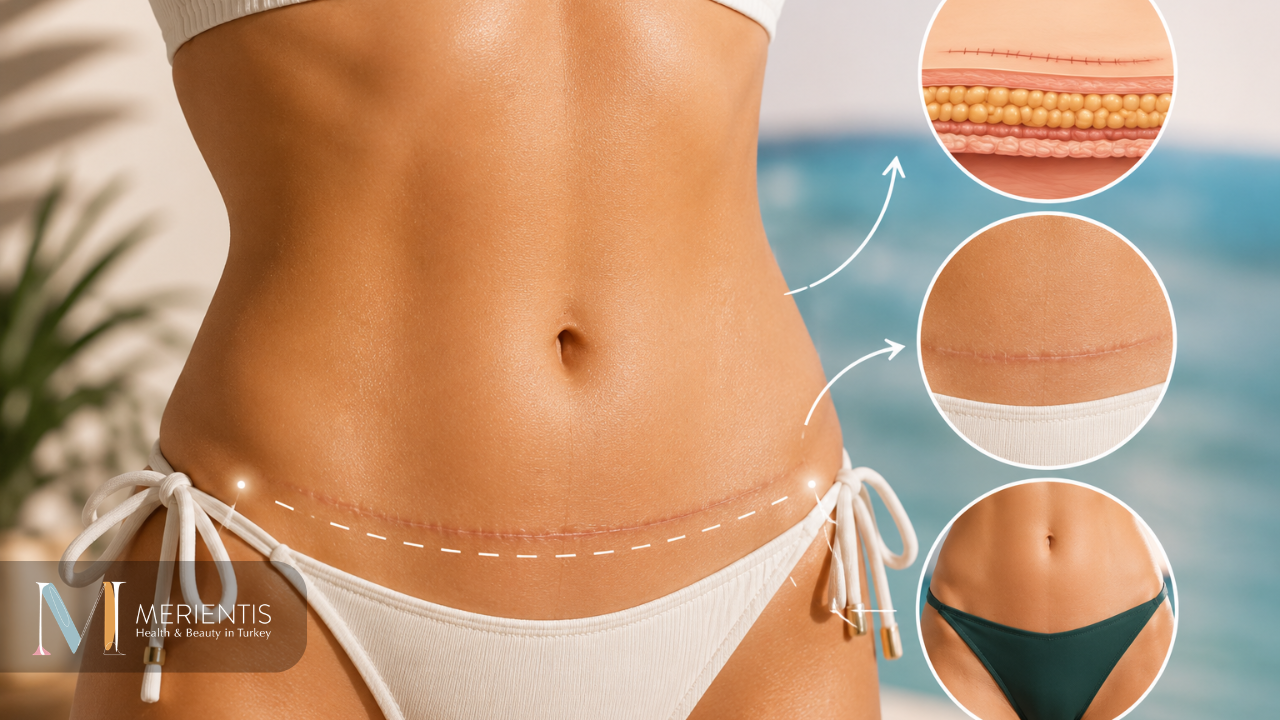
The main tummy tuck scar usually runs horizontally across the lower abdomen. Its length depends on the amount of excess skin, the width of the abdomen and the surgical plan. In a full tummy tuck, there may also be a small scar around the belly button if it needs to be repositioned.
This is an important point: the scar length is not chosen randomly. It is determined by how much skin needs to be removed and how much reshaping is required. A shorter scar may sound more attractive, but if there is significant loose skin, a very short incision may not allow enough correction.
The goal is not simply to make the smallest scar possible. The goal is to create the most appropriate balance between abdominal contour and scar placement for that patient’s anatomy.
Can a Tummy Tuck Scar Be Hidden Under a Bikini?
In many patients, the tummy tuck incision can be planned low on the abdomen so that it is covered by underwear or bikini bottoms. This is one of the most important parts of preoperative marking.
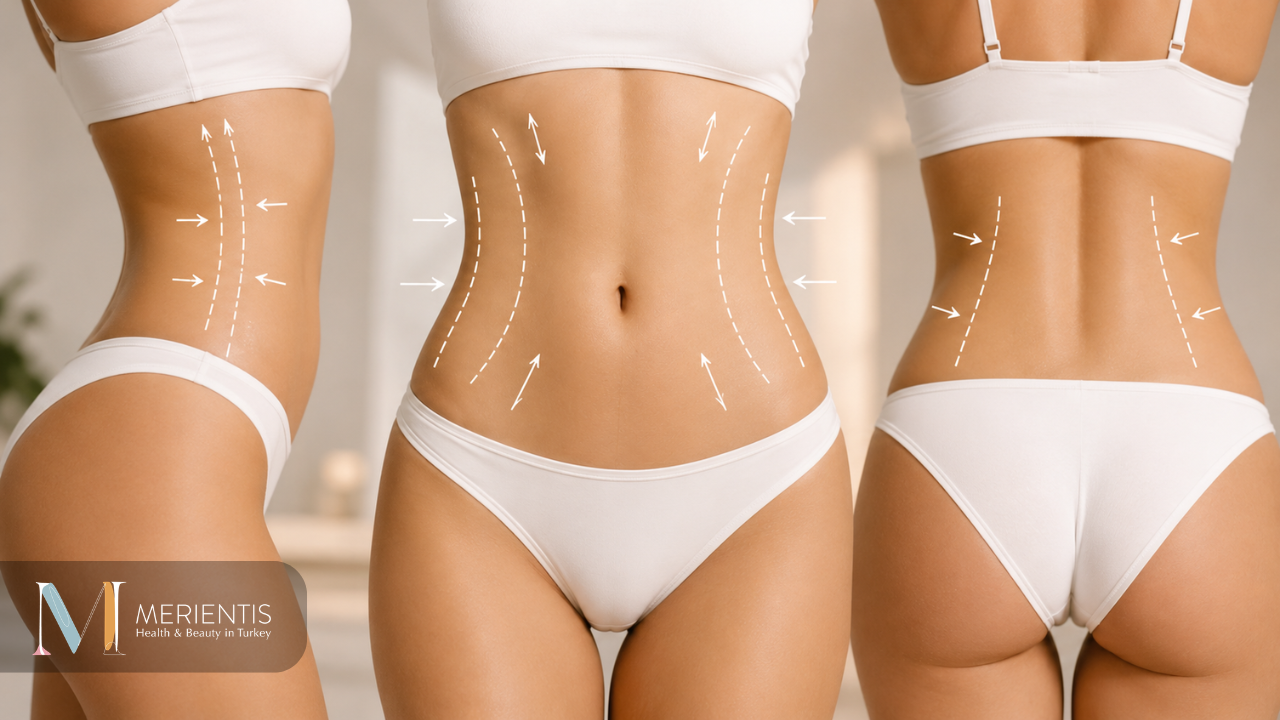
Before surgery, the surgeon usually marks the lower abdominal area while considering the natural skin fold, pubic area, hip line and the patient’s preferred underwear or swimwear style. Some patients even bring their favorite bikini bottom or underwear to the consultation so scar placement can be discussed more realistically.
However, this does not mean every scar can be hidden under every bikini. Very low-cut swimwear, narrow styles or high-leg designs may reveal part of the scar. The patient’s anatomy, amount of skin excess and scar length also matter.
The safest expectation is this: the scar is planned to be as low and discreet as possible, but its final position depends on surgical requirements and healing. Many patients can hide the scar under standard underwear or bikini bottoms, but this should be discussed individually before surgery.
What Does “C-Section Line Planning” Mean?
Many patients ask whether the tummy tuck scar can be placed along the C-section line. This is a common and useful question, especially for women who already have a lower abdominal scar from childbirth.
In some cases, a tummy tuck incision may be planned near the previous C-section scar. Depending on the amount of excess skin and the location of the existing scar, the old C-section scar may even be removed with the excess skin. In other cases, the new incision may be positioned in a similar low abdominal area.
But it is important to be realistic: not every C-section scar can be used exactly as it is. Some C-section scars are too high, too low, uneven, thick or placed in a way that does not match the required tummy tuck incision. The surgeon must plan according to the actual abdominal anatomy.
The phrase “C-section line” generally refers to a low scar area that can be hidden beneath underwear. It does not guarantee that the new scar will be identical to the old scar. The final plan depends on the skin excess, abdominal shape, pubic position, scar quality and desired contour.
Why Low Incision Placement Matters
Low incision placement matters because the lower abdomen is usually covered by underwear, bikini bottoms and many clothing styles. If the scar is positioned too high, it may be visible above swimwear or low-rise clothing.
A low scar can feel psychologically important for patients. Many people are not only concerned about the scar itself, but about whether they can feel comfortable wearing a swimsuit, lingerie or fitted clothing after recovery.
Surgical marking is therefore a key step. The surgeon must consider both aesthetics and safety. The incision should be low enough to be discreet, but not so low that it creates excessive tension, distortion or an unnatural pull on the pubic area.
Good scar planning is not just drawing a line. It is understanding how the skin will move when excess tissue is removed and the abdomen is closed. That is why preoperative assessment should be detailed and personalized.
At Merientis Health in Istanbul, Turkey, this kind of planning is especially important for patients who travel for body contouring surgery and want clear expectations before the procedure.
Does a Lower Scar Always Mean a Better Scar?
Not always. A lower scar is often preferred because it can be easier to hide. But the quality and position of a scar depend on several factors, not only how low it is.
If an incision is placed too low without considering skin tension, it may pull uncomfortably or affect the natural appearance of the lower abdomen. If there is too much tension on the closure, the scar may widen over time. If the patient has a tendency toward thick scars, even a well-placed incision may heal more visibly.
So the aim is not simply “as low as possible.” The aim is “as low as safely and aesthetically appropriate.”
This is why tummy tuck scar planning should balance three things: scar concealment, abdominal contour and healing quality. When these are considered together, the final result can be more harmonious and practical.
What Types of Tummy Tuck Scars Exist?
The scar pattern depends on the type of tummy tuck and the patient’s anatomy. Not every patient needs the same incision.
A mini tummy tuck usually involves a shorter lower abdominal scar and is considered for selected patients with limited lower abdominal skin excess. It does not address the entire abdomen in the same way as a full tummy tuck.
A full tummy tuck usually involves a longer horizontal scar across the lower abdomen and may include a belly button scar. It is often considered when there is more significant skin excess, abdominal laxity or muscle separation.
An extended tummy tuck may involve a longer scar that extends toward the sides or flanks. This may be considered in patients with more extensive loose skin, often after major weight loss.
The appropriate scar pattern is not chosen based only on what the patient wants to hide. It must match the amount and location of excess skin. Choosing too limited an incision for a body that needs more correction may lead to a less satisfying contour.
Can the Scar Be Completely Invisible?
No. A tummy tuck scar cannot be completely invisible. Any surgical incision leaves a scar. Over time, the scar may fade, soften and become less noticeable, but it does not fully disappear.
In the first months, the scar may appear red, pink, firm, raised or darker than the surrounding skin. This early appearance can be emotionally difficult for some patients. They may look at the scar and worry that it will always look the same.
But scars mature slowly. Many scars become flatter and lighter over time. The final appearance depends on skin type, genetics, wound healing, scar care, sun exposure, smoking, tension on the incision and postoperative follow-up.
A realistic goal is not “no scar.” A more realistic goal is a low, well-planned scar that can often be covered by underwear or swimwear and that matures as well as the patient’s body allows.
How Does a Tummy Tuck Scar Change Over Time?
A tummy tuck scar goes through different stages of healing. In the early period, it may look thin but red or pink. As healing progresses, it may become firmer or more noticeable before it begins to soften.
This surprises many patients. They expect the scar to improve every single week, but scar healing does not always move in a straight line. Sometimes a scar looks more visible around the active healing phase before it starts to fade.
Over several months, many scars gradually flatten and lighten. In some patients, scar maturation continues for a year or longer. Darker skin tones or patients with a history of thick scarring may need more careful scar monitoring.
Patience is important. A tummy tuck scar at six weeks is not the same as a tummy tuck scar at six months. The body needs time to remodel collagen and settle into the new contour.
How Can Patients Help Scar Healing?
Scar healing depends partly on surgical technique and partly on the patient’s own biology. But postoperative care also matters.
Patients should follow the surgeon’s wound care instructions carefully. Keeping the incision clean, avoiding unnecessary tension, wearing recommended compression garments and attending follow-up appointments can support a safer healing process.
Smoking should be avoided because it can negatively affect blood flow and wound healing. Sun exposure should also be limited because it can darken scars and make them more visible. Once the incision is fully healed, the surgeon may recommend silicone gel, silicone sheets or other scar care methods.
However, patients should not start scar creams, massage, tapes or laser treatments without medical approval. Timing matters. What is safe at one stage of healing may not be suitable at another.
The best scar care plan is individualized. It should be guided by the surgeon who knows the patient’s incision, skin and healing progress.
Why Underwear and Bikini Style Should Be Discussed Before Surgery
This may sound like a small detail, but it is actually very practical. Patients often have different clothing preferences. Some wear high-waisted underwear, some prefer low-rise bikini bottoms, some wear high-leg swimwear and some choose minimal styles.
The surgeon cannot plan scar concealment properly without understanding what the patient means by “hidden.” A scar that is hidden under one bikini may be visible in another.
Bringing preferred underwear or swimwear to the consultation can help create a more realistic conversation. The surgeon can explain whether the incision can likely be placed under that line or whether anatomical factors may require a different plan.
This conversation also prevents disappointment. Instead of assuming that the scar will be hidden under every possible style, the patient understands what is realistic for her body and her clothing preferences.
What If I Already Have a C-Section Scar?
If a patient already has a C-section scar, the surgeon will evaluate its location, quality and relationship to the planned tummy tuck incision. In some cases, the C-section scar may be removed as part of the excess lower abdominal skin. In others, it may be incorporated into the new incision area.
If the C-section scar is placed very low and the patient has enough excess skin above it, it may be possible to create a new scar in a similar location. If the scar is high, uneven or attached to deeper tissue, planning may be more complex.
Some patients also have a fold of skin hanging over the C-section scar. This is a common concern after pregnancy. A tummy tuck may address the excess skin in suitable patients, but the plan depends on skin amount, abdominal wall condition and overall body structure.
The important point is that the old scar does not automatically decide the new scar. It is one factor in a larger surgical plan.
Can a Tummy Tuck Remove Stretch Marks?
A tummy tuck may remove some stretch marks located on the excess skin that is surgically removed. This most commonly includes stretch marks below the belly button. However, stretch marks outside the removed area may remain.
This is another area where expectations should be clear. Tummy tuck surgery is not a stretch mark treatment. It removes excess skin, and any stretch marks on that removed skin are removed with it. Stretch marks on the remaining skin may still be visible.
Some patients notice that remaining stretch marks look lower or tighter after surgery because the skin has been repositioned. But complete removal of all stretch marks should not be expected.
At Merientis Health in Istanbul, Turkey, this distinction should be explained during consultation so patients understand what the surgery can and cannot change.
What About the Belly Button Scar?
In a full tummy tuck, the belly button may need to be repositioned because the abdominal skin is pulled downward. This usually creates a scar around the belly button.
The goal is to create a natural-looking belly button position and shape, but healing varies from person to person. The belly button scar may be less noticeable over time, especially when it is placed carefully within the natural contour.
Some patients focus only on the lower abdominal scar and forget to ask about the belly button. But the belly button is a central part of abdominal aesthetics. Its position, shape and healing can influence how natural the abdomen looks after surgery.
A complete consultation should include both the lower scar and the belly button scar.
Can Scar Position Change After Surgery?
The scar position may appear to change slightly as swelling decreases, tissues settle and the body heals. The skin is also under different tension in the early postoperative period compared to later stages.
Some upward movement or perceived change can occur depending on the patient’s anatomy and healing. This is one reason why the incision is often planned low from the beginning.
Postoperative swelling, posture, compression garment use and tissue relaxation may also affect how the scar appears in the first months. Early appearance should not be judged as final.
It is helpful to think of the scar and abdominal contour as part of a settling process. Both need time to mature.
Can the Scar Widen?
Yes, a tummy tuck scar can widen in some patients. Scar widening may be related to skin tension, genetics, wound healing, infection, early excessive activity, smoking or individual scar tendency.
The lower abdomen is an area that moves when we stand, sit, bend and walk. Because of this, protecting the incision during early healing is important. Patients should follow activity restrictions carefully.
If a scar becomes wide or thick after healing, scar management options may be discussed. These could include silicone therapy, laser treatments, injections or scar revision in selected cases. However, scar revision is not always needed and should only be considered after proper evaluation.
Prevention and early care are usually better than trying to correct scar problems later.
Is Scar Concern a Good Reason to Avoid Tummy Tuck Surgery?
Scar concern is not a small issue. It is completely valid. A patient should never feel pressured into surgery if she is not comfortable with the idea of a permanent scar.
The decision depends on the trade-off. Some patients feel that the improvement in abdominal contour, removal of loose skin and ability to wear clothing more comfortably is worth the scar. Others may decide that the scar is not acceptable for them.
Neither decision is wrong. The right decision is the one made with full information.
A responsible surgeon should not minimize the scar or promise that it will disappear. Instead, the surgeon should explain where it will likely be placed, how it may heal, what factors affect visibility and whether it can be covered by the patient’s preferred clothing.
Why Realistic Expectations Matter
Tummy tuck surgery can create meaningful changes in abdominal contour for suitable patients. But it is not a scar-free procedure. It also requires recovery, scar care and patience.
Patients should understand that swelling, tightness, bruising, limited movement and scar visibility are part of the early healing process. The final abdominal shape and scar appearance develop gradually.
A patient who expects an instant, perfectly smooth, scarless abdomen may feel disappointed. A patient who understands the process is usually better prepared emotionally and practically.
Expectation management is not about reducing excitement. It is about making the decision healthier. When a person knows what to expect, she can move through recovery with less anxiety.
Why Is Tummy Tuck Surgery Frequently Researched in Istanbul, Turkey?
Istanbul, Turkey is widely researched for plastic surgery and medical tourism. Tummy tuck surgery is one of the procedures many local and international patients explore after pregnancy, weight loss or abdominal skin changes.
Patients often search for information about scar placement, C-section scar planning, bikini line concealment, recovery, belly button shape and whether the result will look natural. These questions are especially important for people traveling from abroad, because they need to plan both surgery and recovery carefully.
At Merientis Health in Istanbul, Turkey, tummy tuck consultation should include a personalized assessment of abdominal anatomy, scar placement, health status, recovery timing and realistic clothing expectations.
For international patients, postoperative follow-up and safe travel timing should also be part of the planning process. A tummy tuck is not just a surgery day; it is a full recovery journey.
What Questions Should You Ask Before Surgery?
Before a tummy tuck, patients should ask direct and practical questions about the scar. This helps avoid misunderstandings.
Useful questions include:
Where will my tummy tuck scar be placed?
Can the incision be planned near my C-section scar?
Will the old C-section scar be removed?
Will the scar be hidden under my preferred underwear or bikini?
How long will the scar be?
Will I also have a belly button scar?
How long does scar healing usually take?
What can I do to support scar healing?
Do I have a higher risk of thick or dark scars?
When can I return to daily life, exercise and travel?
These questions are not superficial. They are part of informed consent. A patient deserves to understand the visible and practical consequences of surgery.
How Should the Scar Be Viewed Emotionally?
A tummy tuck scar can carry emotional meaning. For some patients, it represents a trade-off they willingly accept to remove loose skin. For others, the idea of a scar feels intimidating.
Some women already have a C-section scar and feel comfortable with the idea of a low abdominal scar. Others have never had surgery and may feel more anxious. Both reactions are normal.
It may help to think of the scar not as a failure of the surgery, but as part of the surgery. The goal is to make it as discreet, low and manageable as possible while achieving the required abdominal correction.
Over time, many patients stop focusing on the scar as much as they did in the early weeks. But this depends on healing, expectations and personal body image.
Conclusion: A Tummy Tuck Scar Can Often Be Planned Low, But It Cannot Be Erased
A tummy tuck scar is permanent, but it can often be planned in a low abdominal position so that underwear or bikini bottoms help conceal it. In patients with a previous C-section scar, the incision may sometimes be planned near that area or the old scar may be removed, depending on anatomy and surgical needs.
The key is realistic planning. A tummy tuck scar should not be promised as invisible. It should be explained honestly: where it will be, how long it may be, how it may heal and what clothing may cover it.
At Merientis Health in Istanbul, Turkey, abdominoplasty scar planning should be personalized. The patient’s body structure, skin excess, previous scars, underwear preferences, healing tendency and recovery plan all matter.
“How do we hide a tummy tuck scar under your favorite bikini?” The answer is not a one-size-fits-all trick. It is careful incision planning, low scar placement when appropriate, honest communication and proper postoperative care.
If you are considering tummy tuck surgery, the healthiest first step is to discuss your scar expectations openly during consultation. A good result is not only about a flatter abdomen. It is also about feeling prepared for the scar that comes with it.
Frequently Asked Questions
Can a tummy tuck scar be hidden under a bikini?
In many patients, the tummy tuck incision can be planned low on the abdomen so that it is covered by underwear or bikini bottoms. However, scar visibility depends on anatomy, scar length, clothing style and healing.
Is a tummy tuck scar placed on the C-section line?
Sometimes the scar can be planned near a previous C-section scar, and in some cases the old scar may be removed with excess skin. However, this depends on the location of the old scar and the patient’s abdominal anatomy.
Does a tummy tuck scar disappear completely?
No. A tummy tuck scar is permanent. It may fade, soften and become less noticeable over time, but it does not disappear completely.
How long does a tummy tuck scar take to fade?
Scar maturation varies. Many scars continue improving for several months to a year or longer. Skin type, genetics, tension, smoking, sun exposure and scar care can all affect healing.
Will I have a belly button scar after tummy tuck?
In a full tummy tuck, the belly button is often repositioned, which usually creates a scar around the belly button. The goal is to place it carefully so it blends with the natural contour over time.
Can a tummy tuck remove my old C-section scar?
In some patients, the previous C-section scar may be removed as part of the excess lower abdominal skin. This is not always possible and depends on scar position and surgical planning.
Can a tummy tuck remove stretch marks?
A tummy tuck may remove stretch marks located on the skin that is removed, usually below the belly button. Stretch marks on remaining skin may still be visible.
What affects tummy tuck scar healing?
Genetics, skin type, smoking, sun exposure, wound tension, infection, nutrition, postoperative care and individual healing response can all influence scar appearance.
Can the scar widen after surgery?
Yes, scars can widen in some patients due to tension, genetics, healing issues or early excessive activity. Following postoperative instructions may help support better healing.
Why is tummy tuck surgery researched in Istanbul, Turkey?
Istanbul, Turkey is frequently researched for plastic surgery and medical tourism. Many patients explore tummy tuck surgery for post-pregnancy or post-weight-loss abdominal contouring and want clear information about scar placement and recovery.