What is the golden rule when designing a male nose? Let’s be honest, gentlemen—a man’s nose is the most prominent anchor of his facial character. However, walk down the streets lately and you’ll likely see a recurring trend: noses that look a bit too upturned, too curved, or frankly, too much like they belong on someone else. At Merientis Health, located in the vibrant heart of Istanbul, Turkey, we sit down with men from across the globe every day to discuss this exact issue. What are our “red lines” in male rhinoplasty, and why does a man’s nose require an entirely different engineering mindset compared to a woman’s? Let’s decode the secrets of masculine aesthetics together.
The Golden Rule of Masculine Aesthetics: The Straight Bridge
Where do most mistakes happen in male rhinoplasty? It usually begins by forgetting the gender of the nose. While the gentle “ski jump” curve (supratip break) is a highly coveted feature in female rhinoplasty, on a man, it often results in an artificial, “operated” look that can diminish masculine features. Our core philosophy at Merientis Health is simple: A man’s nose must retain its masculinity.
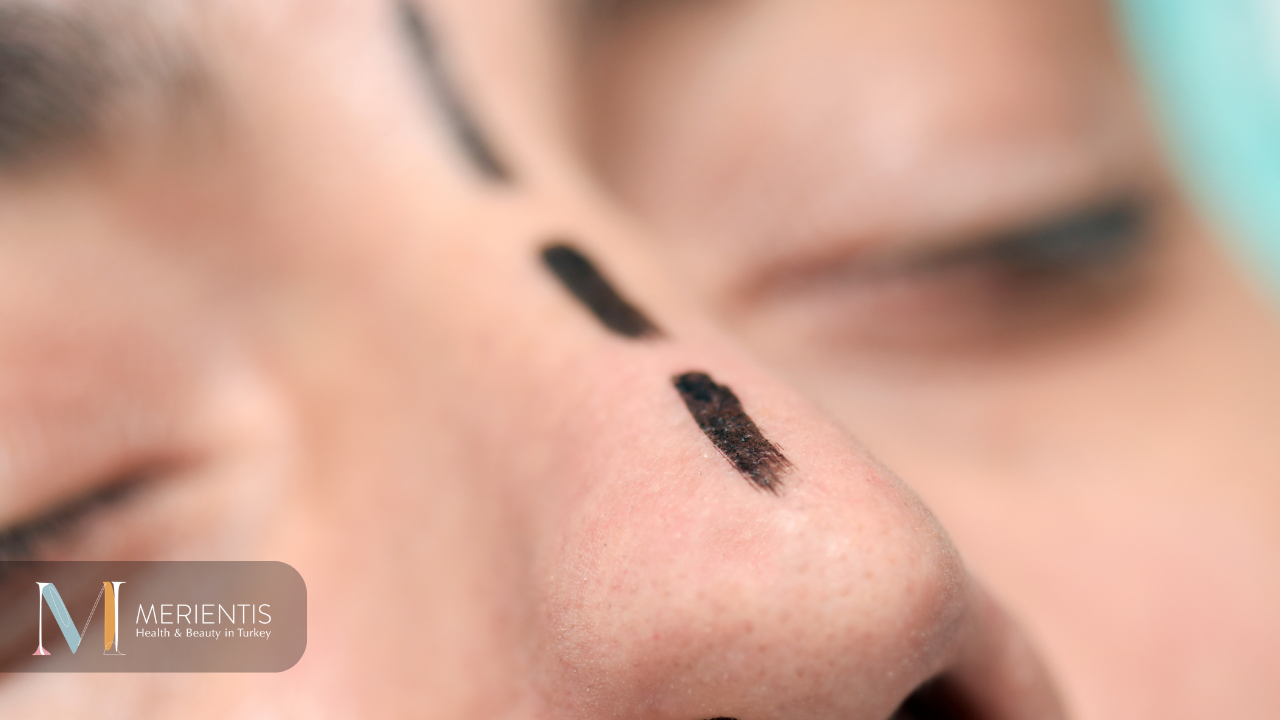
What does this look like in practice? In male rhinoplasty, the nasal bridge (dorsum) should be straight. In some cases, to ensure the nose looks entirely natural and untouched, we might even leave a very slight, intentional “micro-bump.” The goal isn’t to “delete” the nose from the face but to harmonize it with the overall bone structure of the forehead, brow, and chin. In a city like Istanbul, which serves as the global pulse of aesthetic surgery, modern men no longer want to look “done”; they want to look refreshed, distinguished, and authentic.
It’s All About the Angles: The 90-Degree Rule
What truly feminizes a nose is the angle between the tip and the upper lip. In women, an angle of 95 to 105 degrees provides that elegant, slightly upturned look. However, the moment you push a man’s nasal angle beyond 95 degrees, that rugged, masculine expression vanishes.
For men, the ideal nasolabial angle should hover around 90 to 95 degrees. If the tip is rotated any higher, the nostrils become too visible from a frontal view—leading to the dreaded “piggy nose” look that many men fear. In our Istanbul clinic, we use advanced simulations and millimeter-precise calculations to protect this angle. We know that the strength of a man’s face lies in those sharp, defined lines, and a straight, strong nose is the centerpiece of that architecture.
The Challenge of Thick Skin and the Healing Journey
Men’s noses aren’t just visually different; they are structurally distinct. Typically, male skin is thicker and oilier than female skin. This presents both an advantage and a significant challenge for the surgeon. While thick skin is excellent at masking minor internal imperfections, it is much more prone to prolonged swelling (edema).
During our operations in Istanbul, Turkey, we always remind our patients: patience is your most important post-operative tool. In a male patient with thick skin, it can take 1.5 to 2 years for the nose to reach its final, refined shape. It is perfectly normal for the tip of the nose to feel stiff during this period. At Merientis Health, we prefer “Preservation Rhinoplasty” techniques, which minimize trauma to the sub-dermal tissues to help manage this swelling more effectively.
Functionality: A Handsome Nose That Can’t Breathe is a Failure
No matter how handsome a nose looks in a profile photo, the surgery is a failure if it leads to snoring at night or shortness of breath during a workout. Many of our male patients come to us not just for aesthetics, but because of childhood traumas, sports injuries, or deviated septums that have hindered their breathing for years.
Septoplasty (straightening the internal wall) and turbinate reduction (shrinking internal tissues) are inseparable parts of the aesthetic procedure. The reason surgeons in Istanbul are world-renowned is their ability to blend this functional engineering with aesthetic artistry. When you leave the operating table at Merientis Health, you should possess not just a better profile, but a clearer airway.
Why Istanbul and Merientis Health?
Turkey has become a global trendsetter in male rhinoplasty. Why? Because the diverse ethnic backgrounds found in this region have provided our surgeons with incredible experience in handling “strong” nasal structures. We aren’t just practicing surgery; we are practicing the art of balance.
In the breathtaking atmosphere of Istanbul, Merientis Health offers more than just a medical procedure. From your VIP airport pickup to your recovery with a view of the Bosphorus, we handle every detail with discretion and professionalism. For our male patients—many of whom are business leaders or athletes—privacy is paramount. Their motto is usually: “I want the change to be noticed, but I don’t want anyone to know I had surgery.” We provide exactly that—the art of “invisible” aesthetics.
Pre-Op and Post-Op: What Men Need to Know
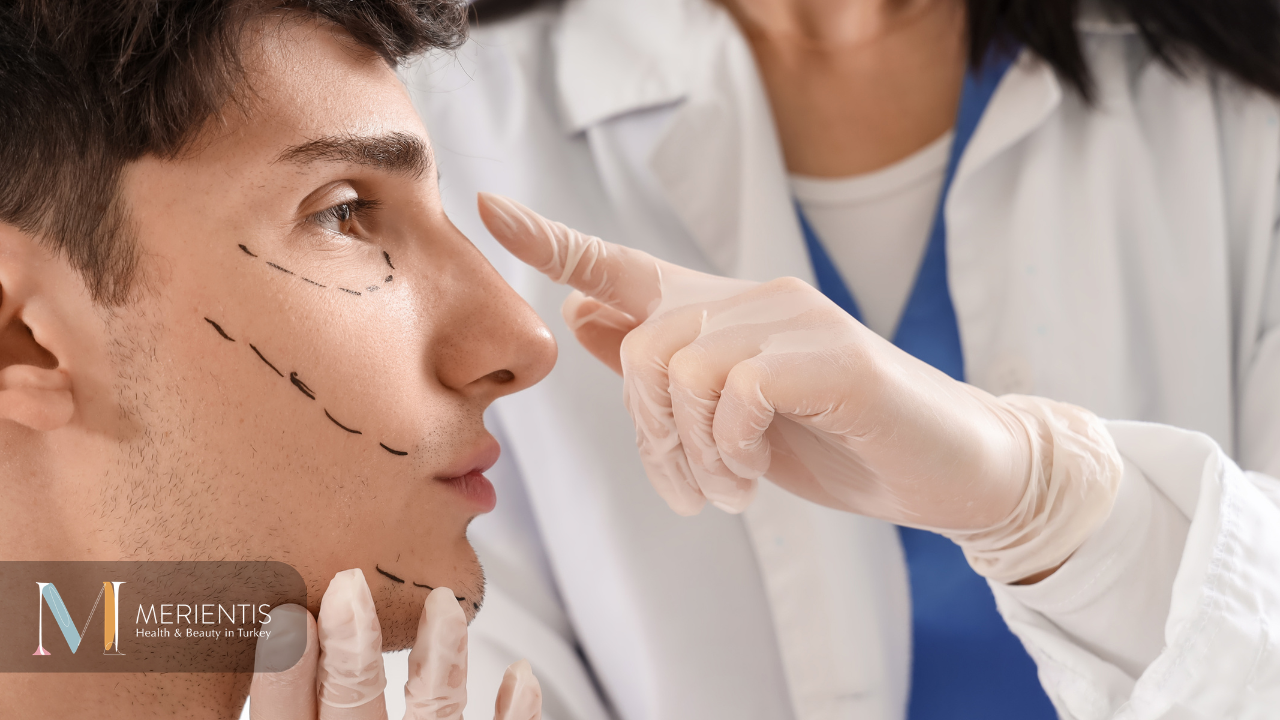
Gentlemen, before embarking on this journey, ask yourself: “What exactly bothers me about my face?” If the answer is “My nose is too big,” we must also look at the rest of your features—your chin and cheekbones. Sometimes, a nose looks large simply because the chin is recessed. This is what we call “Profiloplasty.” By balancing the chin and nose together, we create a much more powerful masculine silhouette.
The first week post-op can be a bit annoying. You might have slight bruising under the eyes or a feeling of fullness due to internal splints. But don’t worry—modern medicine has replaced those painful, old-fashioned gauze packings. We use soft silicone splints that allow you to breathe from day one. By the third day, you can enjoy light walks through the historic streets of Istanbul, letting the city’s energy aid your recovery.
Frequently Asked Questions (FAQ)
1. Does the tip of the nose drop after male rhinoplasty? This is a common fear. In older techniques, the support for the tip was sometimes insufficient. However, with the cartilage grafting methods we use today, we reinforce the tip much like the pillars of a building. At Merientis Health, the risk of a “drooping tip” is minimized through structural reinforcement.
2. Will it be obvious that I had surgery? If we follow our “red lines”—a straight bridge and a 90-degree angle—no one will point at you and say “you had a nose job.” Instead, you’ll likely hear things like, “You look great, did you lose weight?” or “Did you change your hair?” That is the hallmark of a successful masculine result.
3. How long do I need to stay in Istanbul? For the surgery and the initial follow-up, a 6 to 7-day stay in Istanbul is sufficient. On the 6th day, we remove the external splint, and you are cleared to fly back to your home country.
4. When can I get back to the gym? You can start light walks after the first week. However, for heavy lifting, running, or contact sports (like football or basketball) where there is a risk of a blow to the face, you must wait at least 2 months. Your new nasal structure needs time to fully solidify.
5. Should we remove the hump on my nose completely? This is a personal choice. However, we often suggest keeping a very slight straightness or a minimal, natural-looking bridge rather than making it perfectly scooped. This keeps the result “natural” rather than “artificial.”
6. Is the surgery painful? Contrary to popular belief, rhinoplasty is not a painful procedure. Most of our patients describe a feeling of pressure or a “heavy cold” sensation rather than sharp pain. Standard over-the-counter pain relievers are usually more than enough.
Conclusion: Preserve Your Character
Male rhinoplasty is not a “reduction” surgery; it is an “alignment” art. Our job is to keep that strong expression on your face while shifting the focus from a distracting nasal hump to your eyes and your smile. We combine the aesthetic vision of Istanbul with the surgical genius of Turkey.
If you are ready to look in the mirror and see a more masculine, confident, and authentic version of yourself, join the Merientis Health family. Let’s design the perfect profile for you here in Istanbul.
What do you think is the most important feature of a man’s nose? Let’s discuss it in the comments, or contact us today for a personalized analysis!