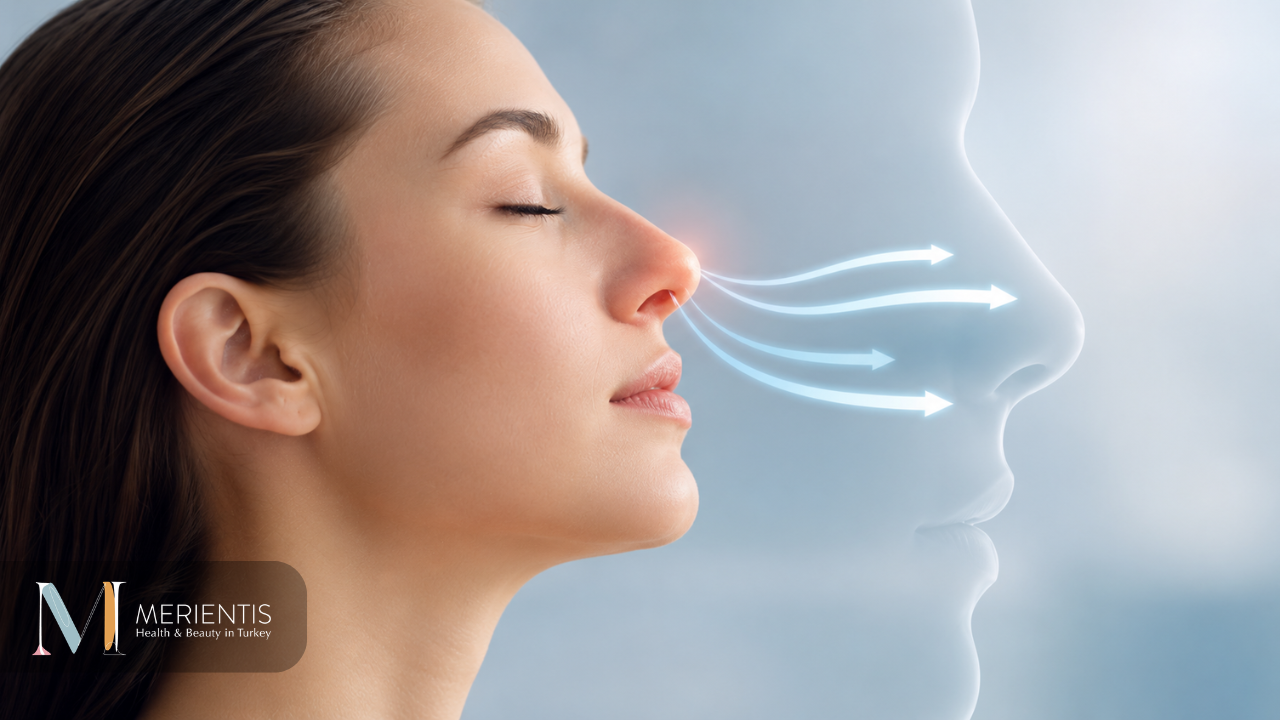
“Your nose may look beautiful… but can you breathe comfortably?”
This question points to one of the most important, yet sometimes overlooked, parts of rhinoplasty. The nose is not only the central feature of the face. It is also a functional organ that helps us breathe, filter air, humidify it, and support daily respiratory comfort.
When people think about rhinoplasty, they often focus on the nasal bridge, nasal tip, profile view, facial harmony, or whether the nose will look natural. These are all important parts of aesthetic planning. But if the nose looks good from the outside while breathing feels restricted, the result may not feel complete for the patient.
This is where the concept of functional aesthetics becomes very important. Functional rhinoplasty is an approach that considers both the external appearance of the nose and the internal structures responsible for breathing. Septum deviation, turbinate enlargement, nasal valve narrowing, nasal tip support, and airflow should all be evaluated together.
At Merientis Health in Istanbul, Turkey, rhinoplasty planning should not only focus on how the nose looks. It should also consider how the nose functions. A well-planned nose surgery aims to support a natural-looking, face-compatible appearance while also respecting the patient’s breathing function.
Because in real life, a nose is not only seen. It is used every second.
Is Appearance Alone Enough in Rhinoplasty?
Rhinoplasty is commonly known as nose reshaping surgery. Many people seek rhinoplasty because they are uncomfortable with the shape, size, bridge, tip, or general appearance of their nose. However, the nose is more than an aesthetic structure. It is the entrance point of the respiratory system.
For this reason, rhinoplasty planning should include both the outside and inside of the nose. While the nasal bridge, nasal tip, asymmetry, width, or profile are being evaluated, the internal airway should also be assessed.
A nose may look balanced from the outside but still cause breathing difficulty due to internal structural problems. A person may feel satisfied with the appearance of the nose in the mirror, yet struggle with nasal congestion, mouth breathing, snoring, poor sleep quality, or difficulty during exercise.
So, what is the real goal of rhinoplasty?
It should not be only a “beautiful nose.” The goal should be a nose that is aesthetically balanced, suitable for the person’s face, and evaluated from a functional point of view. Aesthetic design and breathing function are not opposites. When planned carefully, they should support each other.
Why Can Breathing Problems Occur After Rhinoplasty?
Breathing problems after rhinoplasty may occur for several different reasons. In some patients, breathing difficulty is temporary and related to swelling during the healing period. In other cases, it may be related to structural problems that were already present before surgery or changes in nasal support after surgery.
During the first weeks after rhinoplasty, swelling, crusting, dryness, sensitivity, and internal tissue healing can affect the feeling of nasal airflow. This is often part of the early recovery process. However, if breathing difficulty continues for a long time, worsens, or affects daily life, it should be evaluated by a physician.
The cause is not always a single issue. Septum deviation, turbinate enlargement, nasal valve narrowing, weak nasal sidewall support, nostril collapse, excessive narrowing, or postoperative scar tissue can all contribute to breathing problems.
That is why a complaint such as “I had rhinoplasty, but I cannot breathe well” should not be evaluated only by looking at the outside of the nose. The internal structure, airflow, nasal support, and healing pattern should all be examined together.
What Is Septum Deviation?
Septum deviation refers to a crooked or displaced septum. The septum is the cartilage and bone wall inside the nose that separates the right and left nasal passages. Ideally, it should be close to the midline. However, in many people, the septum may be curved, bent, or shifted to one side.
Some septum deviations are mild and do not cause symptoms. Others may narrow the airway and lead to nasal congestion, one-sided breathing difficulty, mouth breathing, snoring, sleep discomfort, or difficulty breathing during physical activity.
One important detail is this: a nose may look straight from the outside but still have an internal septum deviation. The opposite can also happen. A nose may look slightly crooked externally but may not cause a serious breathing problem.
This is why internal examination before rhinoplasty is important. If septum deviation affects breathing, functional correction may be considered together with aesthetic planning.
Why Is Correcting Septum Deviation Important?
Evaluating septum deviation during rhinoplasty planning is important for breathing comfort after surgery. If the external shape of the nose is corrected but an internal septum deviation that blocks airflow is ignored, the patient may still experience breathing problems after surgery.
The surgical correction of septum deviation is commonly known as septoplasty. Septoplasty aims to reposition or reshape the deviated cartilage and bone inside the nose to improve the nasal airway. When combined with rhinoplasty, it may allow both aesthetic and functional concerns to be addressed in the same surgical process.
However, not every septum deviation requires surgery. The patient’s symptoms, examination findings, degree of airway narrowing, and overall nasal anatomy should all be considered. Mild deviations that do not cause complaints may not need surgical correction.
At Merientis Health in Istanbul, Turkey, evaluating septum deviation during rhinoplasty planning is important for understanding both the patient’s appearance goals and breathing needs. A good rhinoplasty result is not only about how the nose looks in photos. It is also about how comfortable the patient feels in daily life.
What Is Functional Rhinoplasty?
Functional rhinoplasty is a rhinoplasty approach that evaluates breathing function together with nasal appearance. The purpose is not only to reshape the nose externally. It is also to assess and address structures that may affect airflow.
Functional rhinoplasty may involve evaluation of septum deviation, turbinate enlargement, nasal valve narrowing, nasal sidewall support, nasal tip position, and nasal bridge structure. Each of these elements can influence how well air passes through the nose.
A simple comparison may help. Imagine a door that looks elegant from the outside but does not open and close properly. Visually, it may be attractive, but functionally it creates a problem. The nose is similar. Appearance matters, but function matters too.
Functional rhinoplasty approaches the nose as both an aesthetic and functional structure. This is especially important for people with nasal obstruction, trauma-related nasal deformity, septum deviation, nasal valve issues, or breathing problems after a previous rhinoplasty.
What Is the Nasal Valve and Why Is It Important?
The nasal valve is one of the narrowest and most sensitive areas inside the nose. It plays a major role in airflow. When you breathe through your nose, air passes through this region. If the nasal valve is narrow or poorly supported, breathing may feel restricted.
People with nasal valve problems may notice that their nostrils or nasal sidewalls collapse inward when they take a deep breath. Some patients feel more discomfort during exercise, sleep, or when nasal congestion increases. In many cases, nasal valve problems may not be obvious from the outside.
If the nasal bridge is narrowed too much during rhinoplasty, if the nasal sidewall support becomes weak, or if an existing nasal valve problem is not noticed before surgery, breathing difficulty may occur after the operation.
This is why nasal valve evaluation is an important part of functional rhinoplasty planning. At Merientis Health in Istanbul, Turkey, rhinoplasty should not be viewed only as profile correction or nasal tip refinement. The airway and support system should also be part of the overall plan.
Can Enlarged Turbinates Affect Breathing?
Yes. Turbinates, commonly referred to as nasal conchae, are structures inside the nose that help warm, humidify, and filter the air we breathe. They are not unnecessary structures. They are part of healthy nasal function.
However, in some people, turbinates may become enlarged and narrow the airway. Turbinate enlargement may be associated with allergies, chronic nasal congestion, environmental factors, structural narrowing, or long-term irritation.
Patients with enlarged turbinates may feel nasal blockage, especially at night. They may breathe through the mouth during sleep, wake up with a dry mouth, or feel that one side of the nose is blocked more often.
If turbinate enlargement is not evaluated before rhinoplasty, the patient may feel that the nasal shape has changed but the breathing problem continues. That is why internal nasal examination is important in functional planning.
The goal is not to remove the turbinates completely. Since they have an important role, the aim is to evaluate whether their enlargement is contributing to airway obstruction and to decide on a suitable approach based on the individual patient.
Can Aesthetic Rhinoplasty Make Breathing Worse?
A carefully planned rhinoplasty should take breathing function into account. However, as with any surgical procedure, outcomes may vary depending on anatomy, surgical technique, healing response, and individual tissue behavior.
Some patients already have septum deviation, turbinate enlargement, or nasal valve narrowing before surgery. If these problems are not identified and only the external appearance is addressed, breathing complaints may continue after surgery.
In other cases, if the nose is excessively narrowed or if structural support is weakened, new breathing difficulties may develop. This is why rhinoplasty should never be thought of as a simple “nose reduction” surgery.
When the nasal bridge, tip, and nostrils are reshaped, the airway must be protected. A nose that looks aesthetically pleasing but makes breathing difficult may not provide long-term comfort for the patient.
The right question is: “Can this nose look harmonious with the face while also preserving breathing function?” Functional aesthetic planning aims to find that balance.
Temporary Congestion or Long-Term Breathing Problem?
Breathing changes in the early period after rhinoplasty can be normal. Swelling, crusting, internal sensitivity, dryness, and healing tissues may temporarily affect nasal airflow. This can happen during the early recovery process.
However, if nasal obstruction continues for a long time, becomes worse, is clearly one-sided, affects sleep quality, or forces the person to breathe mostly through the mouth, medical evaluation is important. In such cases, the issue may not be only temporary swelling.
Long-term breathing problems may be related to septum deviation, nasal valve narrowing, nostril collapse, turbinate enlargement, internal scar tissue, or insufficient nasal support. These causes can only be understood through proper examination.
A person should not try to diagnose the problem alone. Internal nasal problems are not always visible from the outside. If the nose looks good externally but breathing feels restricted, internal evaluation is necessary.
What Questions Should Be Asked Before Rhinoplasty?
Before rhinoplasty, patients should not only ask, “How will my nose look?” That question is important, of course. But breathing function should also be discussed clearly.
Useful questions may include:
Do I have septum deviation?
Are my turbinates affecting my breathing?
Is my nasal valve area narrow?
How will my breathing function be protected during rhinoplasty?
Could my current nasal obstruction affect the surgical plan?
Will my nose be evaluated both aesthetically and functionally?
These questions help the patient become more informed before surgery. They also help the surgeon understand not only the patient’s aesthetic goals, but also their daily breathing complaints.
Many people researching rhinoplasty in Istanbul, Turkey focus mainly on photos and visual results. But a complete evaluation should include more than image analysis. It should also include internal nasal examination and a detailed discussion about breathing.
Why Can Breathing Problems Develop After a Previous Rhinoplasty?
Some people who have already had rhinoplasty may experience breathing problems afterward. This can happen for different reasons. A previous septum deviation may not have been fully corrected, nasal support may have weakened, the nasal valve area may have narrowed, or scar tissue may have developed inside the nose.
In some cases, the patient may breathe better in the early period but notice changes over time as the tissues settle. In others, swelling may initially hide the underlying problem, and the restriction becomes more noticeable later.
When revision rhinoplasty is considered, the focus should not be only on external appearance. If the main complaint is breathing difficulty, the internal airway and support structures should be carefully evaluated.
Not every breathing problem after rhinoplasty requires revision surgery. In some patients, medical treatment, allergy management, nasal care, or other non-surgical approaches may help. However, if there is a structural problem, individualized surgical evaluation may be necessary.
What Is the Main Goal of Functional Aesthetic Rhinoplasty?
The goal of functional aesthetic rhinoplasty is to evaluate the nose as both an aesthetic and functional structure. The nose should not be treated only as a shape in the middle of the face. It should also be understood as part of the respiratory system.
When the nasal bridge is reshaped, the airway should not be compromised. When the nasal tip is refined, support should not be weakened. When the nostrils and nasal sidewalls are evaluated, airflow dynamics should be considered.
This approach is especially important for patients with septum deviation, nasal obstruction, trauma-related nasal deformity, or breathing problems after a previous nasal surgery. In these patients, changing only the external appearance may not be enough.
At Merientis Health in Istanbul, Turkey, individualized evaluation and realistic patient education are essential parts of rhinoplasty planning. Every nose is different. Every breathing problem has its own cause. Therefore, the surgical plan should be personal.
When Should a Person Seek Evaluation for Breathing Problems?
Everyone may experience temporary nasal congestion from time to time. Colds, allergies, sinus problems, environmental irritation, or seasonal changes can cause temporary blockage. However, when breathing difficulty becomes persistent or affects quality of life, evaluation becomes important.
One-sided nasal obstruction, regular mouth breathing, snoring, dry mouth in the morning, difficulty breathing during exercise, or breathing problems that started after rhinoplasty should not be ignored.
Some people say, “I have always breathed this way; I am used to it.” But long-term nasal obstruction can affect sleep quality, daily energy, exercise comfort, and general well-being. Understanding the cause can be helpful.
The goal is not to create unnecessary fear. But breathing difficulty should not be treated as a small detail either. If rhinoplasty is being planned, any breathing complaint should be discussed before surgery.
The Emotional Side of Breathing Problems After Rhinoplasty
Rhinoplasty is often a decision that takes time. Many patients spend months researching, comparing, thinking, and preparing emotionally. After surgery, they naturally expect both an improved appearance and a more comfortable relationship with their nose.
If breathing problems occur after surgery, the process can become emotionally frustrating. Even if the nose looks good externally, the feeling of “I cannot breathe comfortably” can affect daily life.
Nighttime congestion, mouth breathing, poor sleep, or waking up tired may make the patient feel disappointed or anxious. And sometimes, comments like “But your nose looks beautiful” can make the patient feel misunderstood.
Breathing comfort matters. Aesthetic satisfaction is important, but the patient’s daily experience is equally important. That is why breathing complaints should be taken seriously and evaluated professionally.
Why Functional Rhinoplasty Is Frequently Researched in Istanbul, Turkey
Istanbul, Turkey is one of the most researched destinations for plastic surgery and medical tourism. Rhinoplasty is among the most commonly searched procedures in the city. In recent years, patients have become more aware of the importance of breathing function, not only appearance.
This is a positive shift. A natural-looking nose is valuable, but a nose that supports comfortable breathing is also essential. Patients with previous nasal obstruction, trauma-related nasal deformity, septum deviation, or revision concerns often search specifically for functional rhinoplasty.
Merientis Health in Istanbul, Turkey focuses on patient education and individualized planning in plastic surgery. In rhinoplasty, the external appearance, internal structure, and daily comfort of the patient should be considered together.
Because Istanbul is an important center for international medical travel, many patients also seek clear, realistic, and medically responsible information before making a decision. In this process, transparent communication and functional evaluation are very important.
How Should Realistic Expectations Be Built?
Realistic expectations in functional rhinoplasty begin with understanding that both appearance and breathing must be evaluated individually. Not every septum deviation is the same. Not every turbinate enlargement requires the same approach. Not every nasal valve problem has the same solution.
A patient may want a nose that looks more balanced and also allows more comfortable breathing. This is a very understandable expectation. However, as with all surgical procedures, results may vary depending on anatomy, healing response, and the severity of existing problems.
Before surgery, communication should be clear. What aesthetic changes are being considered? What may be causing the breathing problem? Can septum deviation be addressed during the same procedure if needed? How will nasal support be protected?
These questions help the surgeon create a safer and more appropriate plan. They also help the patient understand the process more realistically.
Conclusion: A Beautiful Nose Should Also Be Evaluated Functionally
Rhinoplasty should not be thought of only as an aesthetic procedure. A nose that looks natural, balanced, and harmonious with the face is important. But breathing function should also be evaluated carefully.
Breathing problems after rhinoplasty may be related to septum deviation, turbinate enlargement, nasal valve narrowing, support loss, temporary swelling, or healing-related changes. The cause should be understood through individual medical evaluation.
At Merientis Health in Istanbul, Turkey, the functional aesthetic approach considers both how the nose looks and how it works. A well-planned rhinoplasty should not only focus on how the nose appears in photos, but also on how the person breathes in daily life.
“Your nose may look beautiful… but can you breathe comfortably?” is not just a catchy question. It is a reminder that true rhinoplasty planning requires balance between aesthetics and function.
If you are researching rhinoplasty or experiencing breathing problems after a previous nose surgery, the healthiest first step is to understand the cause through professional evaluation. A nose should not only fit the face. It should also support the person’s comfort in everyday life.
Frequently Asked Questions
Is breathing difficulty normal after rhinoplasty?
Temporary breathing difficulty may occur in the early healing period due to swelling, crusting, dryness, and internal tissue sensitivity. However, if the problem continues for a long time, worsens, or affects daily life, medical evaluation is recommended.
Can septum deviation be corrected during rhinoplasty?
In suitable patients, septum deviation may be evaluated and addressed during rhinoplasty planning. Whether correction is necessary depends on the patient’s symptoms, internal examination, and nasal anatomy.
What is functional rhinoplasty?
Functional rhinoplasty is an approach that considers both the appearance of the nose and breathing function. Septum deviation, nasal valve narrowing, turbinate enlargement, and nasal support structures may be evaluated as part of this approach.
Can rhinoplasty make breathing worse?
A well-planned rhinoplasty should protect breathing function. However, breathing problems may occur depending on anatomy, surgical technique, healing response, or unrecognized pre-existing issues. This is why functional evaluation is important.
What is nasal valve narrowing?
The nasal valve is a narrow internal area that plays an important role in airflow. If this area is too narrow or poorly supported, breathing through the nose may feel difficult, especially during deep breathing or exercise.
Can enlarged turbinates cause nasal obstruction?
Yes. Enlarged turbinates may narrow the nasal airway and contribute to congestion. However, turbinates have important functions, so any treatment approach should be decided individually.
Does every breathing problem after rhinoplasty require revision surgery?
No. Not every breathing problem requires revision. The cause must first be understood. Swelling, allergies, turbinate enlargement, septum deviation, nasal valve narrowing, or scar tissue may all play a role.
Why is functional rhinoplasty popular in Istanbul, Turkey?
Istanbul, Turkey is widely researched for rhinoplasty and plastic surgery. Many patients now seek not only aesthetic improvement but also functional evaluation, especially if they have nasal obstruction or previous surgery-related breathing concerns.
Can the nose look good externally but still have an internal problem?
Yes. A nose may appear straight or aesthetically balanced from the outside while still having septum deviation, nasal valve narrowing, turbinate enlargement, or other internal airflow problems.
Should I mention breathing problems before rhinoplasty?
Yes. Any breathing complaint should be shared before surgery. Nasal congestion, one-sided obstruction, snoring, mouth breathing, or exercise-related breathing difficulty can affect rhinoplasty planning.